
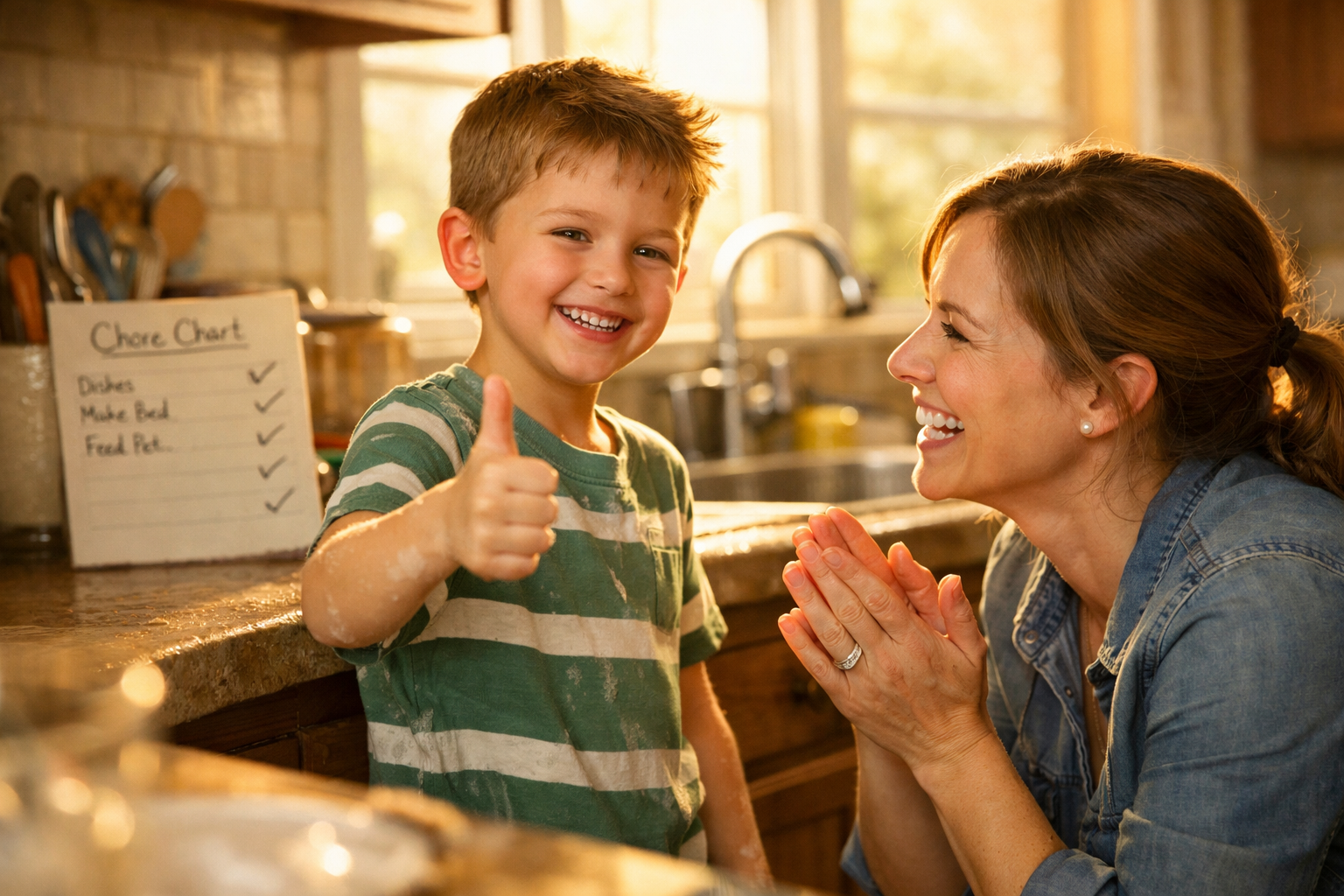
Stop Fighting Your Child's Brain
The science of why willpower doesn't work for kids — and what actually does. How instant rewards, habit loops, and a simple point system can turn daily struggles into lifelong routines.
Stop Fighting
Your Child's Brain
The science of why willpower doesn't work for kids — and what actually does. How instant rewards, habit loops, and a simple point system can turn daily struggles into lifelong routines.
01 / The ProblemSomething Has Changed — and It's Not Your Kid
If you've ever watched your child drag their feet through homework, practice, or chores — but then light up the moment a screen appears — you're not imagining things. Something fundamental has shifted.
In 2024, social psychologist Jonathan Haidt published The Anxious Generation, one of the most widely discussed parenting books in recent memory. His central argument: over the past decade, children's mental health has deteriorated sharply — and the core culprit is a phone-based childhood that has systematically replaced the kind of free, exploratory, real-world experiences that healthy brain development requires.
Haidt describes smartphones as "experience blockers." They don't just consume time — they recalibrate what the brain finds rewarding. A child who gets a little dopamine hit every few minutes from scrolling will increasingly struggle to find satisfaction in slower, deeper activities: reading, practicing an instrument, shooting free throws in the driveway.
Science writer Michaeleen Doucleff puts it even more sharply in her 2026 book Dopamine Kids. Dopamine, she explains, isn't about pleasure — it's about wanting. Kids aren't genuinely in love with TikTok or Minecraft; they're caught in a craving loop. But here's the hopeful part: the dopamine system is remarkably flexible. Parents can actively redirect it. We can make the brain want the right things — we just have to be intentional about how we set things up.
02 / The ScienceHow Habits Actually Form in the Brain
At the neurological level, habits are managed by a region called the striatum. When a behavior is repeated and followed by a reward, the striatum gradually converts that behavior into an automatic program — a neural shortcut that requires almost no conscious effort to execute. This is what we mean when we say something has become "second nature."
A 2025 review in the International Journal of Educational Science confirmed what neuroscientists have long suspected: dopamine plays a central role in habit reinforcement. Each time a behavior is followed by a positive outcome, the neural circuit linking that behavior to its reward gets a little stronger. Repetition, paired with reward, is literally rewiring the brain.
Psychologist Charles Duhigg's classic model captures the mechanism elegantly — the "habit loop":
Habit formation isn't quick. A landmark study by health psychologist Phillippa Lally found that building a new habit takes an average of 66 days — not the "21 days" myth you may have heard. That's a long runway. And for the whole stretch of it, a reliable reward is the fuel that keeps the engine running.
03 / The Development GapWhy Kids Can't Just "Try Harder"
Here's the developmental fact that changes everything: the prefrontal cortex — the brain region responsible for self-control, planning, and delayed gratification — isn't fully developed until around age 25.
For a second-grader, the logical chain of "if I practice piano today, I'll be a better musician in three years" is neurologically nearly inert as a motivator. The wiring for that kind of long-term reasoning simply isn't there yet. Asking a 7-year-old to sustain effort based on distant future payoffs is like asking someone to drive across town using a map of a different city.
Psychologists call this delay discounting — the further away a reward is, the less motivating it becomes. Studies consistently show that children discount future rewards far more steeply than adults do. For a young child, "you'll get a prize at the end of the month" might as well be "you'll get nothing."
— Green & Myerson, 2004, Psychological Bulletin
This is why the most common parenting strategies so often backfire. "You can have a new toy after three months of good grades." "We'll celebrate when you finish the reading program." These aren't bad intentions — they're just rewards timed for an adult brain, not a child's.
The takeaway isn't that kids should never learn to wait. It's that external structure has to compensate for the prefrontal development they don't yet have. That's not coddling — it's developmentally informed parenting.
04 / The MethodToken Economy: A Proven Framework
Clinical psychology has had a highly effective behavior intervention system for decades, broadly called the token economy. Originally used in therapeutic and classroom settings for children with ADHD or behavioral challenges, the research increasingly shows it works just as well in ordinary family life.
The logic is elegantly simple:
-
1
Complete a target behavior → earn points (tokens) immediately
-
2
Points accumulate → and can be exchanged for pre-agreed rewards
-
3
The cause-and-effect chain is clear, visible, and entirely within the child's control
The genius of the token economy is that it solves the delay discounting problem. Earning the point is the immediate reward. Seeing the number go up is its own little dopamine moment. The bigger prize — the thing the child is saving toward — gives the whole system purpose and direction. It's the same psychological architecture as a video game's progress bar, repurposed for real life.
A large 2024 meta-analysis published in the British Journal of Educational Technology — drawing on research spanning 2008 to 2023 — found that gamified reward systems meaningfully improved children's engagement across academic, emotional, and behavioral dimensions. The mechanism? Satisfying children's need for competence and autonomy, in line with Self-Determination Theory.
— Zeng et al., 2024, British Journal of Educational Technology
05 / Task DesignHow to Build a Routine That Actually Sticks
A reward system is only as good as the tasks it's built around. Here are three principles from the research that make all the difference:
Make it specific and concrete. Psychologist Peter Gollwitzer's research on "implementation intentions" shows that when we tie a behavior to a specific time, place, and action — an "if-then" plan — follow-through rates jump dramatically. Not "practice your instrument today," but "after dinner, sit at the keyboard, play for 15 minutes." The more specific the trigger, the more automatic the response.
Match difficulty to ability. Mihaly Csikszentmihalyi's concept of "flow" identifies the sweet spot where challenge and skill are in balance — where a task is hard enough to be engaging, but not so hard it feels impossible. Tasks that are too easy breed boredom; tasks that are too hard breed anxiety. Both kill motivation. Calibrate as your child grows.
Go beyond academics. A well-rounded habit system spans different domains: schoolwork, physical activity, creative practice, and household responsibilities. This reflects what child development researchers call a "whole child" framework — and it has a practical benefit. Competence in one area builds confidence that spills over into others. The kid who's proud of how fast she can jump rope is more likely to tackle a hard math worksheet.
06 / The Long GameFrom External Rewards to Intrinsic Motivation
The most common objection parents raise: "Won't this teach my kid to only do things for rewards? Will they grow up expecting a prize for everything?"
It's a fair concern — and the research has a nuanced answer. Psychologists Edward Deci and Richard Ryan, developers of Self-Determination Theory, did find that rewarding children for things they already intrinsically love can backfire, crowding out their natural enthusiasm. This is called the "overjustification effect."
But here's the critical distinction: for behaviors the child has no existing motivation for, external rewards don't crowd anything out. A second-grader does not have a deep, natural love of multiplication drills. External structure — points, visible progress, a meaningful prize — is the scaffold that gets the habit built. Once the habit is established, the scaffold can come down.
This is also where parental warmth matters enormously. The American Association for Early Childhood Education (NAEYC) emphasized in its 2024 research on self-regulation that responsive, emotionally warm parenting — combined with "scaffolding" support when kids struggle — is the single most powerful factor in building children's self-regulation capacity over time. The point system is the scaffold. Your relationship is the foundation.
07 / Make It WorkA Practical Playbook for Parents
-
1
Build the task list together. Sit down with your child and co-create the daily routine. Kids who have a say in the process feel ownership — and ownership drives follow-through. Keep the list realistic: 4–6 specific, manageable tasks, not 20 aspirational ones.
-
2
Let your child choose the rewards. Create a "reward menu" with items ranging from small to meaningful, each tagged with a point price. When a child is working toward something they actually want, the system runs on its own energy.
-
3
Make progress visible. Points should be something kids can see and feel accumulating — on a whiteboard, an app, a chart on the fridge. The human brain is hardwired to respond to visible progress. Watching a number go up is its own reward.
-
4
Reward effort, not outcomes. Points for completing the task, not for acing the quiz. Children can control whether they show up and practice; they can't always control the result. Rewarding the process keeps the focus where it belongs — on the habit.
-
5
Keep the rules stable. Consistency is how trust gets built. Your child needs to know: if I do the thing, something will happen. Changing the rules midstream — even for good reasons — erodes confidence in the whole system. Commit to it for at least 90 days before evaluating.
-
6
Fade the rewards as habits solidify. Once a behavior has become genuinely automatic — when your child does it without being reminded — start quietly reducing the point value. Increase verbal recognition and emotional celebration instead. This is the handoff from external motivation to internal.
08 / The Big PictureGood Habits Are the Highest-Return Investment You'll Ever Make
We're raising kids in an environment that is, without exaggeration, engineered by the most sophisticated behavioral scientists in the world to capture and hold children's attention. The average app update is tested against thousands of variations to find the one that triggers the most dopamine. Parents are not competing on a level playing field.
But that's exactly why the response can't be passive. The answer isn't to simply restrict screens and hope for the best. It's to deliberately build a competing system — one that offers its own reliable loop of effort, feedback, and reward, anchored not in passive consumption but in real-world achievement.
When a child finishes jumping rope, logs a reading session, or learns to wash the dishes without being asked — and sees immediate, tangible recognition of that — something important happens in their brain. A circuit gets reinforced. A small story gets told: I did something hard, and it mattered.
Your child may not remember, years from now, exactly what they were earning points for. But the discipline, the follow-through, the quiet confidence of someone who knows how to build a habit — that stays. That compounds. That's the investment.
References
- Haidt, J. (2024). The Anxious Generation: How the Great Rewiring of Childhood Is Causing an Epidemic of Mental Illness. Penguin Press.
- Doucleff, M. (2026). Dopamine Kids: How to Raise Children Who Thrive Without Screens. Dutton / NPR Books.
- Zeng, Z. et al. (2024). Gamification in K-12 education: A systematic review of student engagement outcomes. British Journal of Educational Technology.
- Lally, P., van Jaarsveld, C. H. M., Potts, H. W. W., & Wardle, J. (2010). How are habits formed: Modelling habit formation in the real world. European Journal of Social Psychology, 40(6), 998–1009.
- International Journal of Educational Science, Vol. 11 (2025). Neuroscience of habit formation: Striatal mechanisms and dopamine reinforcement.
- Green, L., & Myerson, J. (2004). A discounting framework for choice with delayed and probabilistic rewards. Psychological Bulletin, 130(5), 769–792.
- Deci, E. L., & Ryan, R. M. (1985). Intrinsic Motivation and Self-Determination in Human Behavior. Plenum Press.
- Gollwitzer, P. M. (1999). Implementation intentions: Strong effects of simple plans. American Psychologist, 54(7), 493–503.
- Csikszentmihalyi, M. (1990). Flow: The Psychology of Optimal Experience. Harper & Row.
- NAEYC (2024). Self-regulation and executive function: New frameworks for early childhood practice. Young Children, Summer 2024.
Related reading
- How to Motivate Kids to Do Chores with Virtual Pet Rewards
Use immediate virtual pet feedback and longer-term family rewards to make chores easier to start—without turning every responsibility into a prize.
- How Working Parents Organize Schedules, Chores and Meals
A realistic weekly system for shared schedules, task ownership, meal planning and grocery lists—without making one parent the household dispatcher.
- How to Find School Newsletter Information Later
Find details from an old school newsletter without remembering its subject line. See how Kinmory saves searchable information and links to the source.
- The Mental Load Is Real — and Researchers Just Mapped It
Research on 3,000 US parents shows moms carry 71% of the household mental load. Learn what cognitive labor is, its two hidden types, and how to share it fairly.
Bring your family's plans into one place.
Use Kinmory on the web or phone to share calendars, tasks, meals and the information your household needs next.

Scan to Download
Point your camera here
kinmory.ai/download/kinmory