
ADHD Family Organization: The Science-Based System (2026)
ADHD family organization, grounded in the science: why the default parent burns out, and how a shared, always-visible surface offloads time and memory.
In most families, one person quietly runs the whole operation from memory — the appointments, the permission slips, the "we're out of milk," the who-needs-to-be-where-at-4pm. When that person has ADHD, the job doesn't get easier; it gets impossible in a specific, well-documented way. ADHD family organization isn't about that parent trying harder. It's about moving the executive function out of one overloaded head and onto a surface the whole family can see.
What is ADHD family organization?
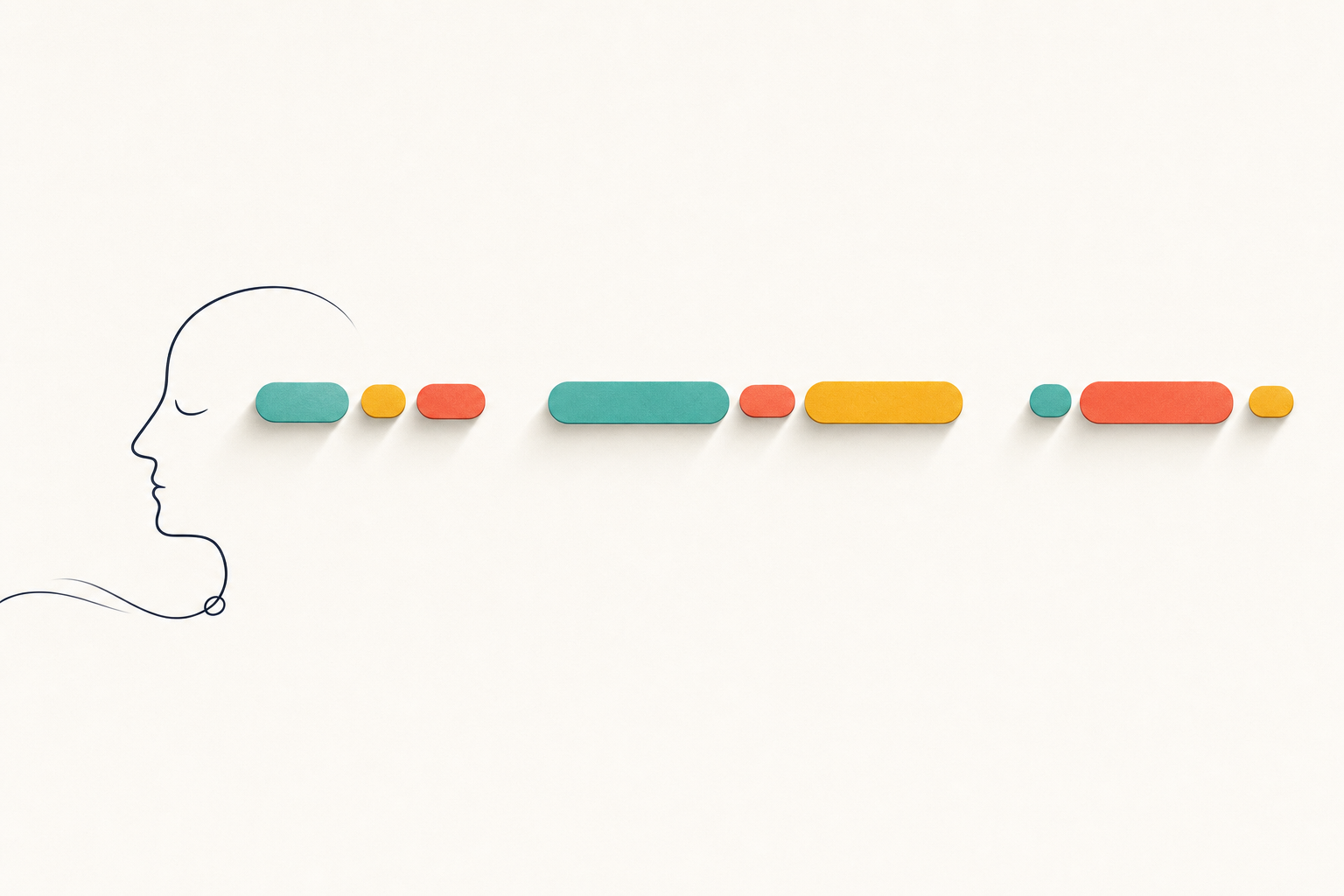
ADHD family organization is the practice of building an external, shared executive-function system — so a household runs on a visible surface everyone checks, instead of on one person's memory and willpower. The goal isn't a prettier calendar. It's to relocate the mental work of remembering, sequencing, and tracking time from inside the "default parent's" brain to somewhere the family can all point at.
That reframing matters because it changes what a good system has to do. If organization lives in one person's head, the whole family has a single point of failure — and in an ADHD household, that point of failure is already carrying more load than a neurotypical one. The fix is architectural, not motivational.
Why ADHD makes family organization uniquely hard
To organize a family, a parent has to hold the future in mind and act on it now: remember Thursday's dentist appointment on Monday, notice that soccer and the recital collide next week, start dinner before everyone is hungry. That is executive function — and it is exactly what ADHD disrupts.
In Russell Barkley's influential 1997 model, ADHD is best understood not as a deficit of attention but as impaired self-regulation — a weakness in the brain systems that bring behavior "under the control of time" and direct it toward the future. Barkley's model holds that this returns behavior to the "temporal now" and produces what he calls a temporal myopia: a blindness to the past, the future, and time in general. (This is the serious construct behind the popular term "time blindness.")
Two consequences fall directly on the organizing parent:
- Working and prospective memory are overloaded. Holding "buy milk, sign the form, leave by 3:40" in mind is costly, and an unfulfilled intention sitting in working memory carries a real cognitive opportunity cost — it quietly taxes everything else.
- The default parent is the family's executive function — while being impaired herself. She's the one who remembers for everyone — the mental load made concrete — which is precisely the function ADHD makes least reliable. As one parent put it, "I'm constantly telling everyone what to do, because if I don't, no one is on task."
It's worth being precise here, because the ADHD community and the clinic don't always use the same words. Difficulty in the sense and estimation of time is a genuine, peer-reviewed cognitive feature of ADHD, so "time blindness" has real grounding. But "object permanence," the popular explanation for "out of sight, out of mind," is a developmental-psychology term that doesn't literally apply — people with ADHD haven't lost object permanence. The accurate description is a mix of prospective-memory failure and the reduced salience of anything not currently in view. The practical implication is the same: if it's off-screen, it may as well not exist.
The principle that changes everything: externalize the executive function
Barkley's model doesn't just describe the problem; it prescribes the shape of the solution. Because ADHD creates disorders "of performance rather than of knowledge," teaching a parent more organizing tips isn't enough — the intervention has to change the environment at what he calls the "point of performance": the exact place and moment where the person would otherwise fail to use what they know. His recommendation is to build "prosthetic environments" that make information physical, external, and public — signs, lists, charts, planners — and to "make time itself more externally represented."
The wider cognitive-science literature explains why this works. Cognitive offloading — using the external world to reduce what your brain has to hold — reliably improves performance across memory, arithmetic, and planning tasks. And the effect on remembering-to-do-things (prospective memory) is striking: in laboratory studies, participants relying on their own memory forgot intended actions roughly 45% of the time, versus about 5% when they set an external reminder — close to a tenfold improvement (Gilbert and colleagues). A 2026 meta-analysis adds two useful findings: offloading helps prospective memory most, and it narrows the gap between higher- and lower-capacity performers — the people who struggle most tend to gain the most.
What a science-based ADHD family system looks like
Translate the science into design requirements and a short, non-negotiable list falls out. A system built for an ADHD family should be:
- External and glanceable, not internal. The information lives on a surface, at the point of performance — not in a parent's head or buried three taps deep in a phone.
- Shared, so it's not one brain's job. If both parents and the kids see the same thing, organization stops being a single person's responsibility to broadcast.
- Forgiving, not shaming. ADHD comes with a heightened sensitivity to perceived failure; a red "overdue" or a broken streak can re-trigger the whole shame narrative and get the tool abandoned. Nudges need to be noticeable but non-punitive.
- Low-friction, with fewer decisions. Every micro-decision to capture or update something is a place the system breaks down. The setup cost of offloading has to be near-zero, because when it's high, people simply don't do it.
How each design choice maps to the science
This is where the abstract principles become concrete. Kinmory's family timeline was designed around exactly these mechanisms — here is each design choice and the research idea it's grounded in. (These are design rationales, not proven clinical outcomes — see the honest section below.)
| Design choice | What it does for an ADHD family | Grounded in |
|---|---|---|
| The whole family's day shown as capsules, at a glance | Moves everyone's schedule out of the parent's memory onto one shared surface — the external family brain | Externalized working memory; intention offloading |
| Free / unscheduled time is labeled explicitly | Makes empty, unstructured time visible — the intervals ADHD tends not to perceive | Making time physical and external |
| Capsule size is proportional to duration | Turns an abstract "1 hour" into something you can see and compare at a glance | Time externalization |
| The view auto-scrolls to the current moment | Answers "where am I now, what's next" without effort — counters the pull toward the "temporal now" | Temporal myopia (time blindness) |
| The schedule is graspable in a single glance | Puts the cue at the point of performance, so no working memory is spent retrieving it | Barkley's "point of performance" |
| Capsules can be dragged, deleted, or rescheduled | Keeps the setup cost of adjusting the plan near-zero, so the system actually stays current | Lowering the cost of offloading |
The same logic extends beyond the phone. Because an ADHD brain deprioritizes what's off-screen, a plan that lives only in an app you have to open still competes with the "out of sight, out of mind" problem. Putting the live timeline on an always-on screen — a tablet you already own, mounted where the family passes — turns it into an ambient, unavoidable cue rather than one more thing to remember to check.
The honest part: what the evidence does and doesn't show
Most ADHD-organization content skips this section. We think it's the most important one — and, frankly, the reason to trust the rest.
- The strongest evidence is about the mechanism, not about ADHD specifically. The offloading and reminder studies above were run on general populations. They're good reason to believe externalizing time and memory helps; they are not proof of an ADHD-family outcome. Anyone telling you a calendar is "clinically proven for ADHD" is overreaching.
- Visual timers help anxiety — not necessarily performance. In a 2025 study, a visible countdown timer significantly reduced children's anticipatory anxiety but produced no measurable gain in task performance. So "seeing time lowers time stress" is fair; "seeing time makes you get more done" is not.
- Even the core theory is debated. Barkley's single-root-cause model is influential but contested; large reviews find executive-function deficits are common in ADHD but "neither necessary nor sufficient." EF challenges aren't universal, which is why we say "Barkley's model holds," not "science proves."
- The one ADHD-specific, randomized-trial-backed intervention here is skills training, not an app. Organizational Skills Training (OST) — structured, clinic-based sessions that teach and reinforce organizing habits — improved organizational functioning in children with ADHD in a 2013 randomized controlled trial (Abikoff et al.). That's real ADHD evidence, but it's about teaching a child skills, not about a family tool. A shared calendar does a different job: it externalizes the system so less has to be held in anyone's head. The two are complementary, not the same claim.
The honest bottom line: the mechanisms are well-supported and the design choices are reasonable applications of them, but a shared family calendar is a well-grounded aid, not a treatment. That distinction is the whole point of doing this rigorously.
Getting started on a screen you already own
You don't need to buy a dedicated device to build an external family brain. The most durable version of this is a live, shared timeline on your phones plus an always-on view on a tablet or old screen you already have, placed where the family naturally looks — the setup often called a family command center.
Kinmory is one option built specifically around these principles: a shared family timeline with duration-sized capsules and labeled free time, an always-on display (KinCals) that turns a spare tablet into the family's live agenda, and AI capture that pulls events from a photo or a forwarded school email so updating the plan costs almost nothing. It's our own app, so treat this as one example of the pattern rather than a neutral recommendation — the principles matter more than the brand, and a plain shared calendar you'll actually keep current beats a fancier one you won't. If you're weighing individual tools rather than a whole-family system, we compared the best ADHD calendar apps head-to-head separately.
For children: add feedback without adding another system
A shared surface can hold the family plan; a child may still benefit from a brief response after completing one concrete action. Our guide to virtual pet rewards for everyday routines shows how that feedback can sit inside the wider family system, including careful limits for ADHD and fading novelty.
Frequently asked questions
Is "time blindness" a real thing or just an excuse?
It has genuine grounding. Difficulty sensing and estimating time is a documented cognitive feature of ADHD, and it maps onto Barkley's idea of "temporal myopia." Making time visible — proportional durations, a marked "now," labeled free time — is a direct response to it.
Do people with ADHD really lack "object permanence"?
No — that's a popular metaphor, not a clinical fact. Object permanence is intact; the accurate description is prospective-memory failure plus the low salience of things that are out of view. The practical takeaway ("out of sight, out of mind") is real even though the term isn't.
My partner with ADHD won't use another app. Does a shared system still help?
That's the most common failure mode, and it's why the surface matters more than the app. An always-on, glanceable display asks for zero adoption effort — nobody has to open or maintain anything to benefit from seeing it. The lower the friction, the likelier it survives.
Will this fix ADHD organization on its own?
No, and be wary of anything that promises that. A shared external system is a well-grounded aid that reduces load; it works alongside — not instead of — skills, routines, and any clinical support. Honest expectations are part of what makes it stick.
- Barkley RA (1997). Behavioral inhibition, sustained attention, and executive functions. Psychological Bulletin 121:65–94. pubmed.ncbi.nlm.nih.gov/9276836
- Barkley RA. ADHD, Executive Function & Self-Regulation (factsheet). russellbarkley.org
- Risko EF & Gilbert SJ (2016). Cognitive Offloading. Trends in Cognitive Sciences 20(9).
- Gilbert SJ et al. (2020/2022). Intention offloading. pmc.ncbi.nlm.nih.gov/articles/PMC9971128
- Burnett LK & Richmond LL (2026). Meta-analysis of cognitive offloading. pubmed.ncbi.nlm.nih.gov/40500483
- Hallez Q & Vallier (2025). Visual timers, anxiety and performance. pmc.ncbi.nlm.nih.gov/articles/PMC12731990
- Abikoff H et al. (2013). Organizational skills training RCT in children with ADHD. pmc.ncbi.nlm.nih.gov/articles/PMC3549033
Related reading
- TimeTree vs Cozi (2026): Which Family Calendar Wins?
TimeTree vs Cozi in 2026: real prices, free tiers, features, and who each family app is for — plus where an AI option like Kinmory fits.
- The ADHD App Graveyard: Why Productivity Tools Don't Stick
Abandoned planners aren't a discipline problem. A calendar's input box sits after the hard thinking—so it offloads the cheapest part and adds a step.
- Intention Offloading: The Science of External Reminders
External reminders cut forgetting from about 45% to 5%. The surprising part: people already offload more than is optimal — and they know why they do it.
- ADHD and the Mental Load: A Gap in the Research (2026)
Cognitive labor has been studied with gender as the variable — never executive function. We map four literatures and the gap where ADHD households fall.
Bring your family's plans into one place.
Use Kinmory on the web or phone to share calendars, tasks, meals and the information your household needs next.

Scan to Download
Point your camera here
kinmory.ai/download/kinmory