

ADHD Time Blindness: The Science Behind the Term (2026)
Time blindness is not one deficit but four. What ADHD research shows about time perception and temporal myopia — and where the adult evidence thins out.
"Time blindness" is real enough to be useful and too coarse to be true. It names something people with ADHD genuinely experience — but it bundles at least four different mechanisms into one word, and the confident version you'll read online rests mostly on studies of children. Here's what it's actually made of, and how good the evidence really is.
What "time blindness" actually means
Time blindness is a popular shorthand for a cluster of difficulties in sensing, estimating, and acting on time — not a diagnosis, and not a single measurable deficit. You won't find it in the DSM. Its closest peer-reviewed relative is temporal myopia, the term from Russell Barkley's 1997 model of ADHD.
Barkley's argument is that ADHD is not fundamentally an attention deficit but an impairment of self-regulation — and specifically of bringing behaviour under the control of internally represented time. In his account, ADHD "returns control of behaviour to the temporal now", producing what he describes as a blindness to past, future, and time in general. The future stops exerting pull. Friday's deadline does not exist until Friday is now.
That's a strong, clear idea. It is also a model — a theoretical account, not an experimental result — and the single-cause version of it is contested. Large reviews have found that executive-function deficits, while common in ADHD, are "neither necessary nor sufficient" to explain it. So when you see "science proves ADHD is time blindness," what's actually being cited is a well-argued theory, attributed to one influential researcher, that not everyone in the field accepts.
It isn't one deficit — it's four
This is the part almost every explainer skips, and it's the part that changes what you do about it. "I lost three hours," "I forgot the appointment entirely," and "I couldn't start until the last minute" are three different failures. They feel like the same thing from the inside. They aren't.
| Mechanism | What it actually is | What addresses it |
|---|---|---|
| Time perception | Estimating, reproducing or discriminating how long an interval lasts — from milliseconds to minutes. Measurable in a lab. | Making duration visible and proportional: a countdown, a progress bar, a block sized to its length. |
| The "temporal now" | Barkley's temporal myopia: behaviour falls back under the control of the immediate context; future events lose their grip. | Making the future physically present: a visible timeline, a marked "now", the distance to the next thing stated in minutes. |
| Prospective memory | Remembering to do a thing later. This is a memory failure, not a perception failure — your clock was fine; the intention evaporated. | External reminders and cues placed where the action happens. Nothing about seeing time helps here. |
| Temporal discounting / delay aversion | Future rewards lose value disproportionately fast — a competing account of ADHD (Sonuga-Barke's delay-aversion model) that is about motivation, not timing. | Neither timers nor calendars fix this. Shortening the delay to reward does. |
Notice what falls out of that table: a visual timer and a reminder solve different problems, and neither touches the fourth. When someone says "time blindness" and someone else recommends a timer, they may not even be discussing the same failure. Being specific about which one is breaking is the first genuinely useful move.
What the evidence shows, layer by layer
| Layer | What it shows | How solid |
|---|---|---|
| Children & adolescents | Zheng et al. (2022), a meta-analysis of 27 studies — 1,620 participants with ADHD vs 1,249 controls — found an overall effect of g = 0.688 (95% CI 0.570–0.806), medium-to-large, across both time estimation and time reproduction. | Robust — but children and adolescents only. |
| Adults | Mette (2023), reviewing a decade of adult studies, found only 5 of 9 studies demonstrated a clear deficit; 3 found no clear association. Where deficits appeared: estimation d = 0.42–1.5, reproduction d = 0.44–0.97. | Mixed and thin — the author states adult studies are "very scarce", methods vary widely, and there are no validated instruments. |
| Theory | Barkley (1997): ADHD returns behaviour to the temporal now; the prescription is to externalize time at the "point of performance". | A model, ADHD-specific but not an efficacy trial; the single-cause version is contested. |
| Is timing the root cause? | Unresolved. Mette concludes the relationship between timing, executive function, working memory, delay aversion and impulsivity is not sufficiently clear, and is likely multifactorial — noting working memory and interval reproduction are "closely connected". | Open question — don't let anyone tell you it's settled. |
Why the adult picture matters more than anyone admits
Read those first two rows together, because the gap between them is the story.
The strong, quotable number — a medium-to-large deficit, replicated across 27 studies — comes from children and adolescents. The people typing "am I time blind" into a search box at 1am are overwhelmingly adults. And in adults, the evidence is genuinely mixed: fewer than half the studies in Mette's review found a clear deficit, the effect sizes that did appear ranged from small to large, and the author is explicit that the literature is scarce, methodologically heterogeneous, lacks validated measurement instruments, under-represents women, and rarely controls for comorbidity.
What follows — and what doesn't
Here's the useful thing about the unresolved primary-versus-secondary debate: the practical conclusion survives it either way.
If your internal clock is genuinely less precise, an external one helps. If your timing is fine but your working memory can't hold the plan while you're doing something else — the connection Mette flags as close — an external plan helps. Both roads lead to the same prescription, which is the one Barkley made explicit: because ADHD produces problems "of performance rather than of knowledge", the fix isn't more insight, it's changing the environment at the point where the failure occurs, and making time itself externally represented.
What does not follow is the productivity promise. In a 2025 study, a visible countdown timer significantly reduced children's anticipatory anxiety — but produced no measurable improvement in task performance. Seeing time reliably lowers time stress. It does not, on the evidence, make you get more done. Anyone selling you the second thing is going past what the research supports. We go through the rest of those claims in our honest evidence review of external calendars and ADHD.
What externalizing time actually looks like
Translate the four mechanisms into design requirements and they stop being abstract:
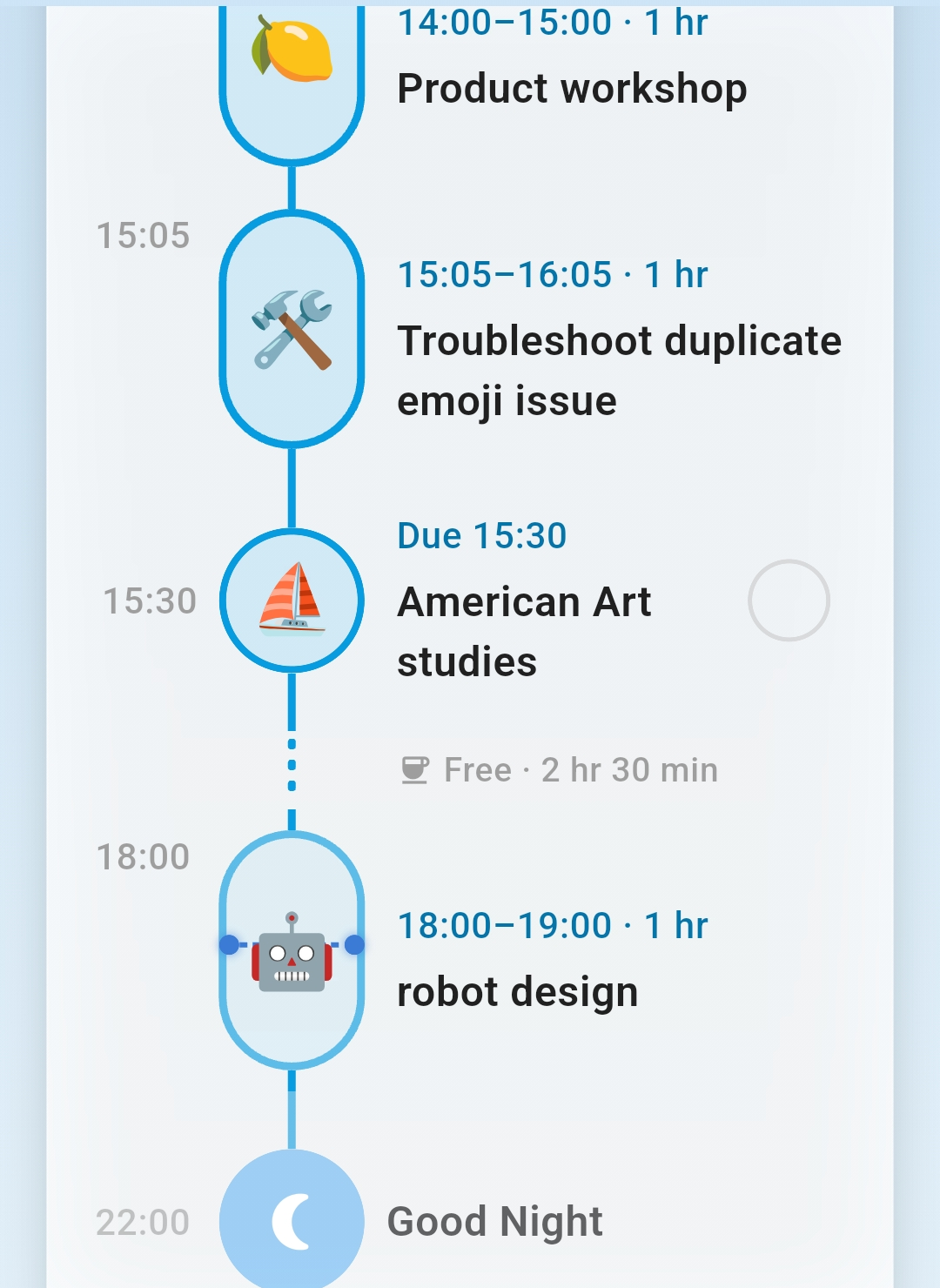
- Duration should be visible, not inferred. "60 min" is a number you have to convert; a block whose length is its duration is something you read at a glance. This targets time perception directly.
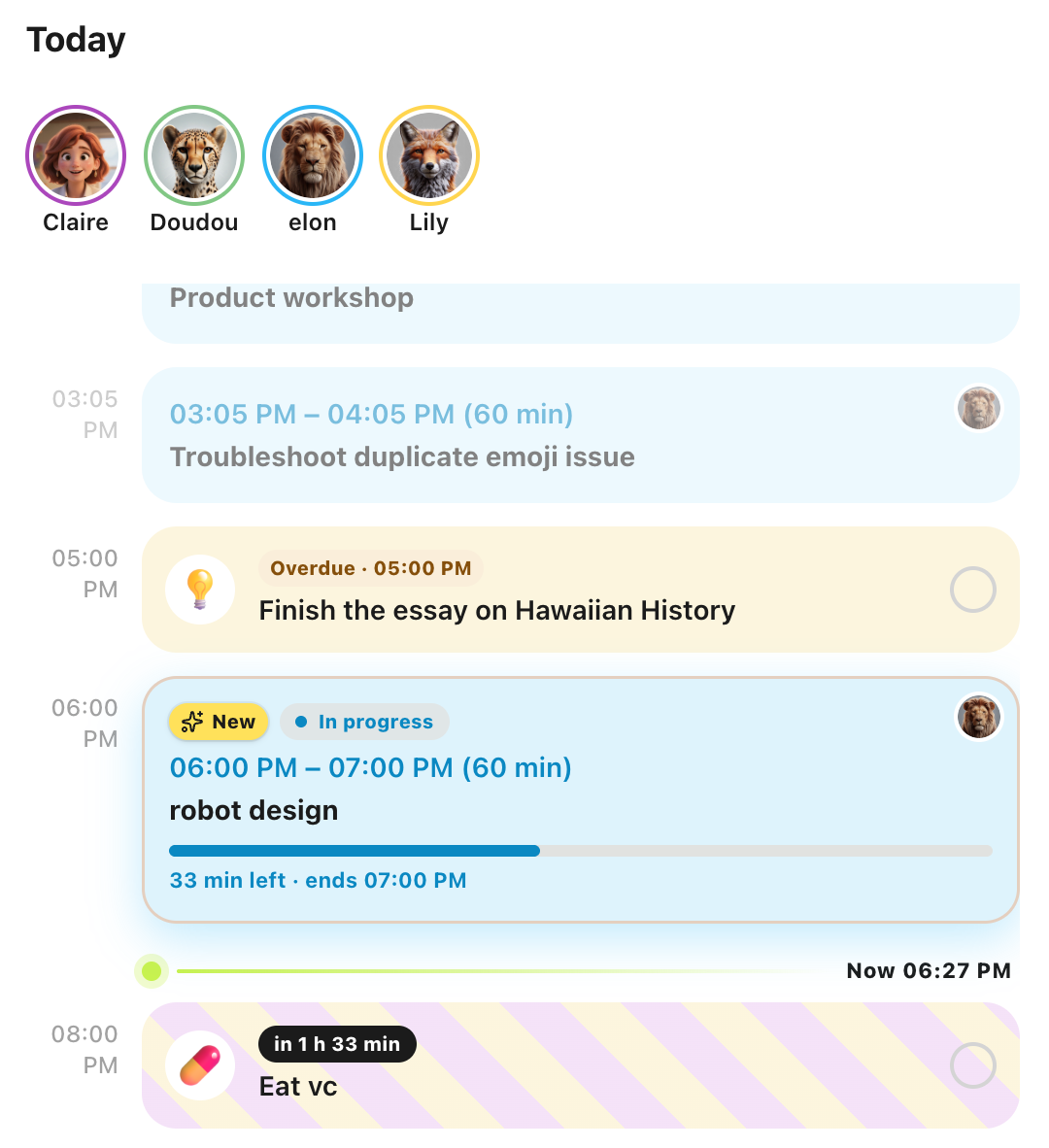
- "Now" should be marked, not calculated. A live line across the day answers "where am I" for free — the direct counter to falling back into the temporal now.
- Elapsing time should be shown while it elapses. A progress bar reading "33 min left" is the Time Timer principle applied to the thing you're actually doing — with the honest expectation that it lowers time anxiety rather than boosting output.
- Distance to the future should be stated, not implied. "in 1 h 33 min" is a different cognitive object from "8:00 PM". One requires arithmetic against an unreliable internal clock; the other doesn't.
- Empty time should be labeled. Unstructured gaps are the least perceptible part of a day. Naming a gap "Free · 2 hr 30 min" turns invisible time into a thing you can see and spend deliberately.
- Overdue should be visible but not punishing. A red accusation re-triggers the failure narrative; a calm flag conveys the same information without the shame tax.
This is the design brief we built Kinmory's family timeline against. Since it's easier to show than describe, here it is — our own product, included because we built it against the mechanisms above, not the other way round:
The reasoning behind the whole system is laid out in ADHD family organization: the science-based system. If you'd rather compare individual tools, we've done that in best ADHD calendar apps. None of that makes a calendar a treatment — see the caveats above — but the design principles follow from the mechanisms rather than from marketing.
Frequently asked questions
Is time blindness a real medical condition?
No — it's popular shorthand, not a diagnosis, and it does not appear in the DSM. The nearest peer-reviewed concept is temporal myopia from Barkley's model of ADHD, and there is measurable evidence of time-perception deficits, particularly in children.
How strong is the evidence for time blindness?
It depends on who you mean. In children and adolescents, a 2022 meta-analysis of 27 studies found a medium-to-large deficit (g = 0.688) in both time estimation and reproduction. In adults, a 2023 review found only 5 of 9 studies showed a clear deficit, and describes the adult literature as very scarce and lacking validated instruments.
Is time blindness the cause of ADHD?
Unresolved, and probably the wrong question. Reviewers conclude the relationship between timing, working memory, executive function and delay aversion is multifactorial and not yet clear. Barkley's model puts time near the centre; competing models like delay aversion do not.
Do timers fix time blindness?
They help with one part of it. A visible timer makes duration perceptible and has been shown to reduce anticipatory anxiety, but the same study found no improvement in task performance. And a timer does nothing for prospective memory — forgetting to do the thing at all is a different failure that needs an external reminder, not a clock.
- Zheng Q, Wang X, Chiu KY, Shum KK (2022). Time Perception Deficits in Children and Adolescents with ADHD: A Meta-analysis. Journal of Attention Disorders. doi:10.1177/1087054720978557
- Mette C (2023). Time Perception in Adult ADHD: Findings from a Decade — A Review. Int. J. Environ. Res. Public Health 20(4):3098. doi:10.3390/ijerph20043098
- Barkley RA (1997). Behavioral inhibition, sustained attention, and executive functions. Psychological Bulletin 121:65–94. pubmed.ncbi.nlm.nih.gov/9276836
- Barkley RA. ADHD, Executive Function & Self-Regulation (factsheet). russellbarkley.org
- Hallez Q & Vallier (2025). Visual timers, anticipatory anxiety and performance. pmc.ncbi.nlm.nih.gov/articles/PMC12731990
- Willcutt EG et al. (2005). Validity of the executive function theory of ADHD: a meta-analytic review.
Related reading
- TimeTree vs Cozi (2026): Which Family Calendar Wins?
TimeTree vs Cozi in 2026: real prices, free tiers, features, and who each family app is for — plus where an AI option like Kinmory fits.
- The ADHD App Graveyard: Why Productivity Tools Don't Stick
Abandoned planners aren't a discipline problem. A calendar's input box sits after the hard thinking—so it offloads the cheapest part and adds a step.
- Intention Offloading: The Science of External Reminders
External reminders cut forgetting from about 45% to 5%. The surprising part: people already offload more than is optimal — and they know why they do it.
- ADHD and the Mental Load: A Gap in the Research (2026)
Cognitive labor has been studied with gender as the variable — never executive function. We map four literatures and the gap where ADHD households fall.
Bring your family's plans into one place.
Use Kinmory on the web or phone to share calendars, tasks, meals and the information your household needs next.

Scan to Download
Point your camera here
kinmory.ai/download/kinmory