

How Children Build Self-Direction in Grades 2–4
An evidence-informed framework for helping children start tasks, regulate effort, and become less dependent on adult prompting.
Evidence synthesis · Version 0.2
How Children Build Self-Direction in Grades 2–4
The aim is not to change a child's personality. It is to build skills, environments, and adult-child routines that still work when support is gradually removed.
Abstract
Procrastination, repeated prompting, difficulty beginning homework, and trouble switching from play to a required task should not be treated as proof that a child is lazy or lacks character. In children in grades 2–4, the same outward behavior can reflect an unclear first step, a task that exceeds current skill, weak transition cues, fear of failure, insufficient sleep, high distraction, or a family loop in which the adult has become the child's starting signal.
The most defensible direction in the current literature combines clear structure with age-appropriate autonomy. Adults initially co-regulate: they clarify the task, externalize steps, model strategies, and help the child recover from emotion or error. The child then practices those processes in real tasks while prompts are deliberately reduced. The outcome that matters is not completion while an adult is present, but performance after adult support has faded.
This article summarizes a working method, not a validated universal curriculum. Evidence is stronger for self-regulation, autonomy support, contextualized learning strategies, implementation intentions, sleep, and physical activity than it is for the specific claim that a home program will reliably shorten homework-start latency in every child.
Self-direction is not one trait
“Self-drive” is everyday language, not a single established psychological variable. For research and practice, it is more useful to separate six observable constructs:
- Autonomous motivation: whether the child experiences the action as understood or endorsed, rather than merely compelled.
- Task initiation: the time between an agreed cue and the first effective action.
- Executive function: holding a goal in mind, inhibiting an immediate impulse, switching activities, and changing strategy.
- Self-regulated learning: planning, monitoring, evaluating, and adapting.
- Emotion regulation: continuing through boredom, frustration, uncertainty, or an imperfect first attempt.
- Prompt dependence: how much adult reminding, supervising, correcting, or organizing is required.
The appropriate target is therefore not “personality change.” It is improvement in plastic skills, habits, environmental conditions, and interaction patterns, followed by a test of whether those improvements remain when help is reduced.
What the evidence supports
| Direction | What the evidence suggests | Use |
|---|---|---|
| Autonomy support plus structure | Need support and autonomous motivation are positively associated; causal and long-term evidence is less direct. | Core principle, without promising personality change. |
| Planning–monitoring–evaluation | Learning-strategy interventions are most credible when taught inside authentic school tasks. | Teach, model, practise, then fade the checklist. |
| If–then plans | A 2026 meta-analysis of 42 studies found a small-to-moderate average effect on goal attainment, with substantial heterogeneity. | Use as a low-complexity starting tool. |
| Executive-function training | Near-task gains are possible, but long-term maintenance and transfer to daily life are uncertain. | Do not make brain-training software the main intervention. |
| Sleep and physical activity | Both relate to attention, emotion, and executive function; sleep recommendations are health guidance, not a procrastination treatment. | Check foundations before interpreting attitude. |
| Rewards and praise | Effects depend on whether feedback conveys useful competence information or is experienced as control. | Keep rewards brief, specific, and designed to fade. |
A method model built around support withdrawal
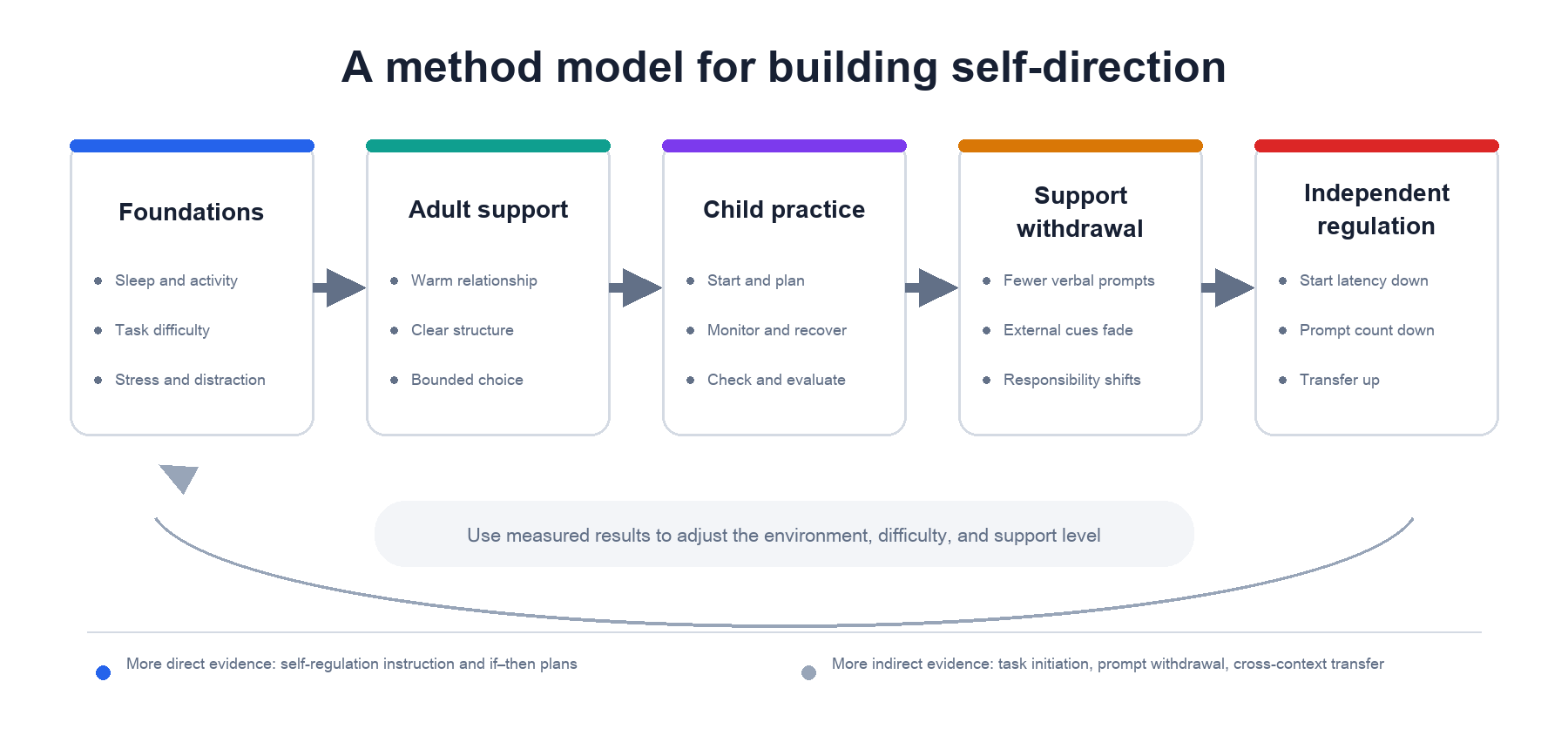
The model has five operating principles:
- Check capacity and conditions before attitude. Clarify whether the child understands the task, possesses the required skill, has slept adequately, and can work in the current environment.
- Adults set boundaries; children participate in the path. Non-negotiable goals can coexist with bounded choices about order, place, tools, or break timing.
- Train the process, not the person. Feedback should name the observable strategy—how the child started, checked, asked for help, or recovered—not label the child as lazy, gifted, or unmotivated.
- Every support needs an exit rule. A checklist, timer, or reminder should specify when it will be reduced or replaced by a less intrusive cue.
- Measure independence, not completion alone. Ninety percent completion with declining prompts may represent more development than perfect completion under continuous adult control.
A testable twelve-week prototype
This prototype is a practical hypothesis assembled from several evidence streams; it has not been validated as one standardized program.
- Baseline, two weeks: observe start latency, adult prompts, independent completion, recovery time, sleep opportunity, and task type without launching a reward system.
- Weeks 1–2: stabilize sleep opportunity, workspace, materials, predictable timing, and task clarity.
- Weeks 3–4: train a minimal visible first action and one if–then plan tied to a stable cue.
- Weeks 5–6: teach a short plan, calibrate difficulty, and model how to identify the likely sticking point.
- Weeks 7–8: practise monitoring, error recovery, emotion naming, and a pre-agreed help-seeking rule.
- Weeks 9–10: expand bounded choice and give the child a real responsibility with visible consequences.
- Weeks 11–12: reduce verbal reminders, test another subject or setting, and retain only supports the child can use independently.
How to measure progress
Do not rely only on grades or a global impression of “being more motivated.” Use repeated, low-burden measures:
- Start latency: minutes from the agreed cue to the first effective action.
- Adult prompt count: reminders needed from preparation through completion.
- Independent completion: proportion of tasks completed without an adult organizing the content.
- Recovery time: time needed to resume after distraction, error, or emotional interruption.
- Strategy use: whether the child independently plans, monitors, seeks help appropriately, and checks work.
Interpret change across several weeks and task types. A short-term rise in errors can occur when adults stop over-organizing; that may be part of the transfer of responsibility rather than evidence of failure.
What not to make the main method
- Repeated prompting and continuous supervision without a fading plan.
- Shame, comparison, threats, or stable personality labels.
- Using material rewards as a substitute for competence, autonomy, and usable strategy.
- Growth-mindset slogans without appropriate difficulty and instruction.
- Standalone brain-training software without evidence of transfer to real tasks.
When a broader assessment is warranted
A general habit-building approach cannot replace clinical or educational assessment. Consider professional evaluation when attention, organization, forgetting, impulsivity, distress, or avoidance persists for months, occurs in two or more settings, and materially affects learning, relationships, or daily life. Sleep disorders, anxiety, depression, sensory problems, and learning difficulties can resemble poor motivation. Procrastination alone does not establish ADHD.
Methods and evidence boundary
This version is an evidence-informed synthesis, not a completed systematic review or meta-analysis. It prioritizes systematic reviews, meta-analyses, consensus recommendations, and research directly relevant to children, while distinguishing correlation from intervention evidence and near-task outcomes from independent everyday behavior. The proposed causal chain and twelve-week sequence remain testable methodological inferences.
Product independence: The article does not evaluate a Kinmory product and does not turn an evidence gap into a product-effect claim. The central success criterion—independent regulation after support is reduced—should be measured regardless of the tool used.
Selected references
Bureau, J. S., et al. (2022). Pathways to student motivation: A meta-analysis of antecedents of autonomous and controlled motivations. PubMed.
Xu, J., et al. (2024). Parental homework involvement and students' achievement: A three-level meta-analysis. PubMed.
Pandey, A., et al. (2018). Effectiveness of universal self-regulation-based interventions in children and adolescents. PubMed.
Takacs, Z. K., & Kassai, R. (2019). The efficacy of different interventions to foster children's executive function skills. PubMed.
Breitwieser, J., et al. (2026). The effectiveness of implementation intentions in children: A systematic review and meta-analysis. British Journal of Psychology.
Selman, S. B., et al. (2024). Routines and child development: A systematic review. Journal of Family Theory & Review.
American Academy of Sleep Medicine. (2016). Recommended amount of sleep for pediatric populations. Consensus recommendation.
Macnamara, B. N., & Burgoyne, A. P. (2023). Do growth mindset interventions impact students' academic achievement? PubMed.
Related reading
- How to Motivate Kids to Do Chores with Virtual Pet Rewards
Use immediate virtual pet feedback and longer-term family rewards to make chores easier to start—without turning every responsibility into a prize.
- How Working Parents Organize Schedules, Chores and Meals
A realistic weekly system for shared schedules, task ownership, meal planning and grocery lists—without making one parent the household dispatcher.
- How to Find School Newsletter Information Later
Find details from an old school newsletter without remembering its subject line. See how Kinmory saves searchable information and links to the source.
- The Mental Load Is Real — and Researchers Just Mapped It
Research on 3,000 US parents shows moms carry 71% of the household mental load. Learn what cognitive labor is, its two hidden types, and how to share it fairly.
Bring your family's plans into one place.
Use Kinmory on the web or phone to share calendars, tasks, meals and the information your household needs next.

Scan to Download
Point your camera here
kinmory.ai/download/kinmory