
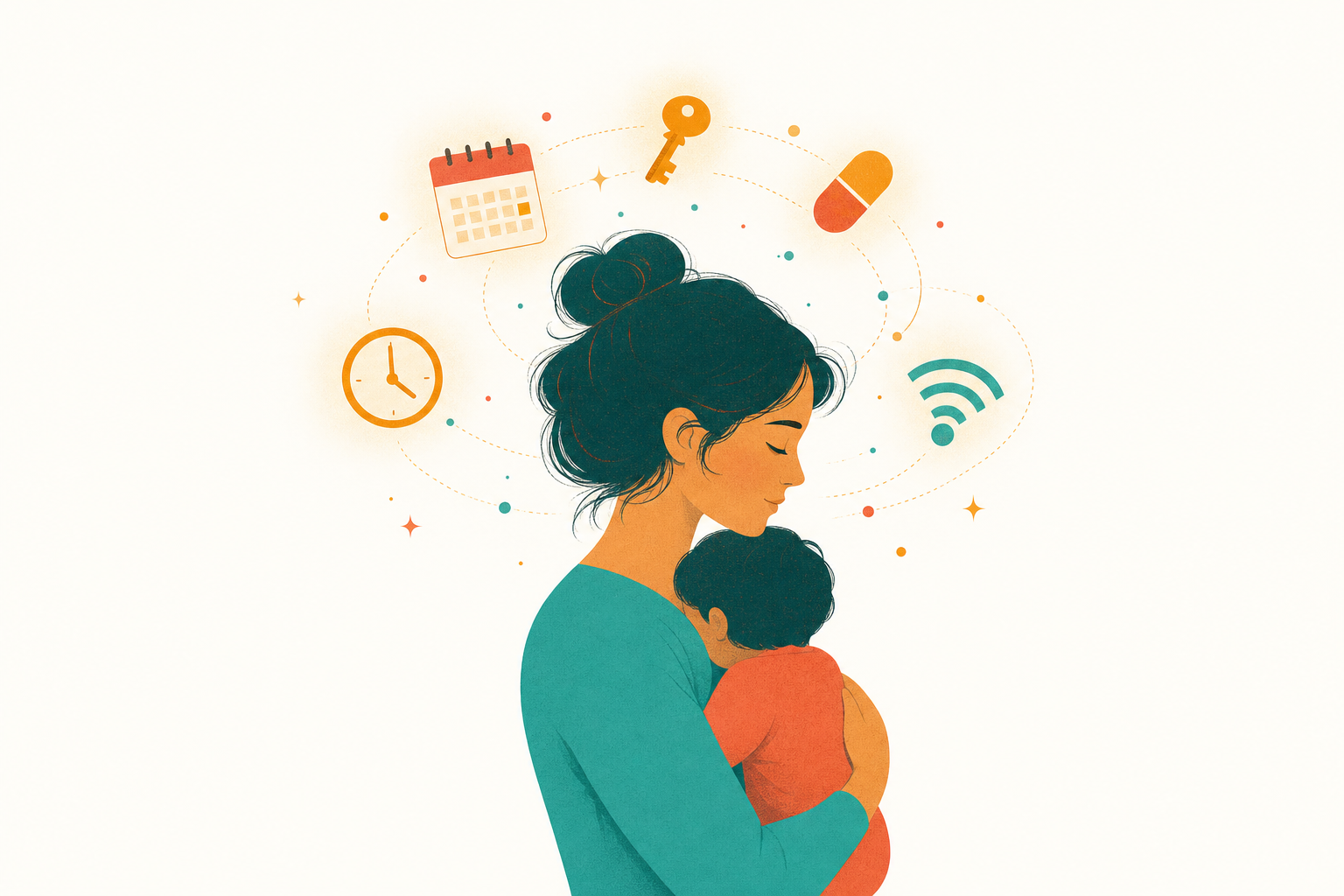
You Are Your Family's Human Hard Drive
One parent holds every appointment, allergy, and password in their head. Why a family's memory is the hardest part of the mental load to share.
In most families, one person has quietly become the database. They know the pediatrician's number, which child is allergic to what, where the passports live, when the car registration is due, and the Wi-Fi password nobody else ever learned. It looks like having a good memory. It is actually a job — the least visible layer of the mental load, and the one that is almost impossible to hand off. Here is why, and what actually changes it.
The parent who remembers everything
Every household has one. Ask where the spare key is, when the dentist appointment is, what size shoes the youngest wears, or what the plumber's name was — and everyone turns to the same person. That person isn't remembering these things because they're organised. They're remembering because someone has to, and no one else volunteered for the role.
The cost is real and it is cumulative. Holding a household's worth of facts in one head is not free storage; it is a standing background task that never fully switches off. It is why the "keeper" is the one who wakes at 2am remembering the form is due tomorrow, and why they can't fully rest on holiday — the database travels with them. We've written before about why the mental load is real; this piece is about its most overlooked component: not the doing, and not even the planning, but the remembering.
Why memory is the hardest layer of the load to share
You can hand someone a task. You cannot hand them what you know. That's the crux. Sociologist Allison Daminger, studying the cognitive dimension of household labour, breaks that invisible work into four steps: anticipating a need, identifying options, deciding, and monitoring the outcome. Chores are the part that's visible and, in principle, splittable. The anticipating and monitoring — noticing the milk is low before anyone asks, tracking that the prescription needs refilling on the 14th — are the parts that stay stuck to one person, because they live in that person's head as knowledge, not on a list as a task.
A chore ends when it's done. Being the family's memory never ends — the moment one fact leaves your head, another arrives, and the running total only grows.
This is why "just split the chores more evenly" doesn't touch the real imbalance. You can divide the visible work down the middle and still leave one person holding the entire body of household knowledge that decides which chores exist in the first place. The remembering is upstream of the doing, and it's the part that never appears on the whiteboard.
The evidence: it is measurable, and it is lopsided
This isn't a feeling; it has been measured. A 2024 study from the University of Bath and the University of Melbourne, analysing roughly 3,000 US parents in the Journal of Marriage & Family, found that mothers carry about 71% of the household's mental-load tasks — the cognitive work of scheduling, planning, and organising — compared with 45% for fathers. For the daily, recurring mental load specifically, mothers reported responsibility for 79% of tasks versus fathers' 37%.
And researchers have now built an instrument to measure it. A team at Wake Forest University, in a paper memorably titled "Who's Remembering to Buy the Eggs?" (Journal of Business and Psychology, 2023), developed and validated a nine-item scale for "invisible family load," splitting it into managerial, cognitive, and emotional dimensions. Across their studies, women reported higher levels on every dimension — and the load spilled over into health, wellbeing, and work.
Why the usual fixes don't fix it
The advice given to the family memory-keeper almost always makes the load their problem to solve better — which is why none of it works. Each common fix leaves the knowledge sitting in exactly the same place: one person.
| The usual advice | What it actually does | Where the memory still lives |
|---|---|---|
| "Just get more organised" | Asks the keeper to run their private database more efficiently | Still one person — now with higher standards to meet |
| Make a list / use a notes app | Writes facts down, but the list is one more thing to maintain and remember to open | One person, plus a second chore: keeping the list current |
| Shared family calendar | Genuinely helps with scheduled events — the "when" | Silent on the "what": allergies, where things are, sizes, account details |
| A "second brain" / notes app | Powerful, but built for one knowledge worker's private system | Dies with that one person's discipline; the family can't query it |
| Voice assistant that "remembers" | Can store and recall a fact by voice — a real, useful thing | Tied to one account; it isn't a pool the whole family shares |
| A shared family memory | Anyone stores a fact — by voice or a photo — and anyone can ask for it back | The household, not one head. This is the layer that's been missing. |
Notice the pattern. Every row except the last keeps the memory in a single place — usually a single person, occasionally a single person's app. The problem was never that the keeper needed a better filing system. The problem is that the filing system was a person, and people can't be shared, backed up, or asked a question while they're at work.
The real fix: memory that's shared and can be asked out loud
If the load is heavy because one person is the memory, the fix isn't a better tool for that person. It's moving the memory somewhere the whole family can both add to and draw from — so that "ask Mum" is replaced by "ask the house."
Two properties make the difference, and almost everything on the market has at most one of them:
- Shared, not solo. A memory only one person maintains is still that person's job — it has just moved from their head to their phone. The load lifts only when anyone can contribute a fact and anyone can retrieve it. A teenager should be able to add "coach moved practice to Thursdays," and a partner should be able to get the pharmacy's number, without going through the keeper.
- Retrievable without effort. A store you have to remember to open, and then search, is one more thing to manage — it re-creates the load it was meant to remove. The retrieval that actually helps is the one you can do with your hands full and your eyes elsewhere: ask, out loud, and get the answer.
The goal isn't to remember more. It's to be allowed to forget — safely — because the household remembers for you.
How Kinmory approaches it
This is the gap Kinmory is built around, and Memory Note is the piece aimed squarely at it. The idea is deliberately narrow: let any family member drop a fact into a shared memory the easiest way possible — say it, or snap a photo of it — and let anyone in the family get it back later just by asking. The insurance card, the field-trip form, the "we keep the good scissors in the second drawer," the make and model of the filter that needs replacing: captured in seconds, held for the household rather than for one person, and available to whoever needs it next.
The point isn't a cleverer note-taking app. It's a change in who holds the knowledge. When the memory belongs to the family instead of to the default parent, the keeper stops being a single point of failure — and stops being the only one who can answer the question.
The deeper argument for why offloading what you carry is rational rather than a sign of a poor memory — and where the science is honestly still unsettled — is one we've laid out separately in the research on intention offloading and in our note on ADHD and the mental load.
Frequently asked questions
What is the "mental load" of being the family's memory?
It's the ongoing cognitive work of holding a household's facts in your head — appointments, allergies, where things are kept, account details, who needs what and when. Researchers call this cognitive or "invisible" family load. Unlike a chore, it never finishes: it's the standing job of being the person everyone asks.
Why is remembering harder to share than chores?
You can assign a task, but you can't hand someone the knowledge in your head. Sociologist Allison Daminger describes cognitive labour as anticipating, identifying, deciding, and monitoring — and the anticipating and monitoring stay with one person because they live as private knowledge, not as a visible task on a list.
Do mothers really carry most of the mental load?
In a 2024 University of Bath and University of Melbourne study of about 3,000 US parents, mothers were responsible for roughly 71% of household mental-load tasks versus 45% for fathers, and 79% of daily mental-load tasks versus fathers' 37%. A separate Wake Forest scale found women reporting higher "invisible family load" across every dimension it measured.
Won't a shared list or family calendar solve it?
They help with part of it. A shared calendar handles scheduled events — the "when." But a list is one more thing to keep current and remember to open, and neither holds the "what": allergies, where items are stored, sizes, account details. The load lifts only when the memory is both shared (anyone can add or retrieve) and effortless to reach (you can just ask).
How is this different from a voice assistant that already remembers things?
A single-user assistant can store and recall a fact for one account. The missing piece for families is a shared memory: a pool any family member can add to and any member can query, so the knowledge belongs to the household rather than to one person's device or one person's head.
- Daminger, A. (2019). The Cognitive Dimension of Household Labor. American Sociological Review 84(4):609–633.
- University of Bath & University of Melbourne (2024). Gender divisions in daily and episodic cognitive household work. Journal of Marriage & Family. (Univ. of Bath announcement, Dec 2024 — "mothers manage 7 in 10 mental-load tasks".)
- "Who's Remembering to Buy the Eggs? The Meaning, Measurement, and Implications of Invisible Family Load" (2023). Journal of Business and Psychology. doi:10.1007/s10869-023-09887-7 (research led at Wake Forest University).
Related reading
- A Family Organization System Should Survive a Busy Week
A resilient family organization system favors quick capture, visible next actions and easy recovery over perfect routines and constant maintenance.
- The Family Information Handoff Problem
A practical way to stop school notices, appointments and family tasks from getting lost between inboxes, conversations and calendars.
- How Household Information Work Is Measured
A methods audit of how researchers observe household information work: units of analysis, data sources, visible processes, and recurring blind spots.
- The Missing Map of Household Information
A structured evidence map of how families receive, interpret, allocate, store, transfer, retrieve, act on, and monitor everyday information.
Stop keeping the whole household in one person's head.
Capture useful family facts by voice, photo or supported source, then let permitted family members ask for them later.

Get the Mobile App
Scan with your phone
kinmory.ai/download/kinmory