
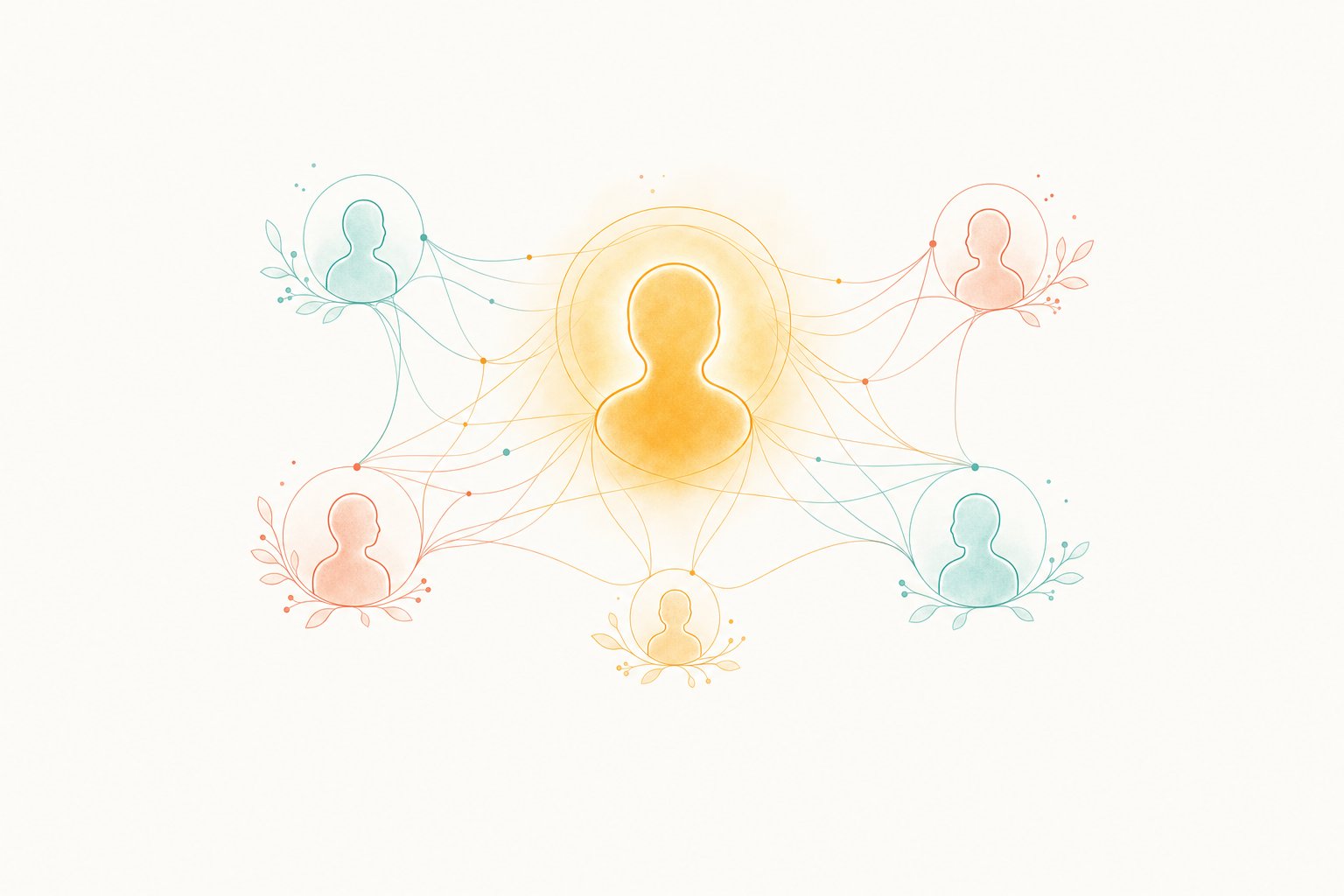
What Is Transactive Memory? How Families Share Knowledge
A research-grounded guide to transactive memory: its definition, evidence from couples, limits, and what it may explain about family mental load.
There is a name for the thing close partners do without formally designing it. One person knows the medical history; another knows where the tools are; each learns who is likely to remember what. Psychologists call this transactive memory. The research is real—but applying it to household mental load requires a careful line between direct evidence and product interpretation.
What is transactive memory?
Transactive memory is a system through which members of a close group divide responsibility for remembering information and maintain a shared directory of who knows what. The group can access more knowledge collectively because each person remembers some information directly and knows where other information can be retrieved.
Daniel Wegner developed the concept in his 1987 chapter, Transactive Memory: A Contemporary Analysis of the Group Mind. “Group mind” here does not mean that people think identically. It describes a coordinated memory system built from individual memories plus knowledge about other members’ expertise.
A transactive memory system is usually described through three related processes:
- Encoding: members learn which person is likely to know or remember a type of information.
- Storage: responsibility for different knowledge is distributed instead of duplicated in every person.
- Retrieval: a member recalls the information directly or consults the person believed to hold it.
What does the research directly show?
The strongest early evidence concerns close couples—not entire modern households using an app. In a 1991 study of 118 people in dating relationships, Wegner, Erber, and Raymond compared established couples with impromptu pairs. Natural couples recalled more when allowed to use their existing implicit division of knowledge, but performed worse when the researchers imposed a category structure that conflicted with it.
| Source | What was studied | What it supports | What it does not establish |
|---|---|---|---|
| Wegner, 1987 DOI 10.1007/978-1-4612-4634-3_9 | Theoretical analysis of memory distributed across close groups | The definition and encoding–storage–retrieval model of transactive memory | That a particular family app improves memory or mental load |
| Wegner, Erber & Raymond, 1991 DOI 10.1037/0022-3514.61.6.923 | 118 individuals in established dating couples or impromptu pairs completing a memory task | Established partners can develop useful implicit knowledge specializations | How household scheduling, parenting, or caregiving responsibilities are divided |
| Hewitt & Roberts, 2015 DOI 10.3389/fpsyg.2015.00516 | Development and validation of a transactive-memory scale for couples | Transactive memory can be studied as a relationship-level construct involving knowledge coordination | That every family has an effective or equitable memory system |
| Sparrow, Liu & Wegner, 2011 DOI 10.1126/science.1207745 | Four experiments about expected future access to information | People may remember where information can be accessed instead of the information itself | That an AI assistant is equivalent to a trusted human partner |
The finding that may help explain the family memory-keeper
When the researchers assigned the couples a memory structure — told them who should remember which category — the couples got worse, and now underperformed the strangers.
Established couples remembered better than strangers when left alone, and worse than strangers when a structure was forced on them. The implicit "who remembers what" was doing real work — and overriding it broke something.
Applied cautiously to household life, this offers a useful hypothesis. Whoever books the pediatrician may become “the one who knows the doctor stuff.” Other members may remember where to ask rather than encoding the details themselves. Over time, the household’s directory can point repeatedly to one person. The couple-memory studies did not measure this parenting pattern, but the theory gives us precise language for investigating it.
How the shared system quietly becomes one person
The failure mode isn't dramatic. It's that the distribution was never even. Three things push a family's transactive memory onto a single person:
| How it drifts | What it looks like at home | Why it sticks |
|---|---|---|
| Whoever encoded it, owns it | The parent who filled in the school form is now "the one who knows the school stuff" | Others never stored it — they stored "ask them," so they genuinely can't take over |
| The directory outgrows the person | One head now indexes four people's medical, school, financial and logistical facts | Retrieval still routes through them, so they can never fully step away |
| The store has no backup | When that person is sick, travelling, or simply out, the family stalls | A memory living in one brain has no redundancy — there is no second copy to query |
This is one possible mechanism underneath what we've called being the family's human hard drive. Mental-load research documents imbalances in anticipating, planning, and remembering household needs; transactive memory offers a separate framework for asking who stores which knowledge and how other members retrieve it. Connecting the two is a reasoned synthesis, not yet a settled experimental finding.
We already added a transactive memory partner — the internet
Here's the encouraging part, and it's also from Wegner's lab. Humans don't only offload memory onto each other; we offload it onto reliable external stores, and we do it readily. In a 2011 Science paper on what they called the "Google effect," Sparrow, Liu and Wegner found that when people expect to have future access to information, they remember the information itself less well — and remember instead where to find it.
That result is sometimes reduced to a claim that technology damages memory. The experiment supports a narrower conclusion: expected access changed what participants recalled, shifting recall toward where information could be found. It does not show that every external store is dependable or that offloading always improves performance. We cover the wider evidence and trade-offs in our article on intention offloading.
What a better shared node would need
If a household experiments with a shared external store, the theory suggests several design questions rather than guaranteeing a fix. Is the source trusted? Can members retrieve it when needed? Do they know what the system contains? Can responsibility be shared without erasing privacy or the authority of original records?
- Any member can contribute. A store one person maintains recreates the single overloaded node. The point is to let the teenager add "coach moved practice" and the partner add the new insurance details, so the directory no longer points at one head.
- Any member can retrieve, without a ritual. Offloading only helps if retrieval is cheap. The internet won as a memory partner because the answer is a search away. A family store needs the same: ask, get the fact, done.
- It survives one person's bad week. The value of a second copy is that the system doesn't stall when the keeper is out. Redundancy is the whole point of not keeping it in one brain.
A family doesn't need to remember more. It needs a shared node that isn't a person — one everyone can write to and everyone can ask.
What does this imply for an AI family wiki?
The research does not tell families to use a specific product. It does suggest that a useful external system must make both the information and its access path understandable. An AI family wiki can be evaluated by whether authorized family members can contribute information, retrieve an answer, inspect the original source, and connect relevant facts to current plans without routing every question back through one person.
This is the model Kinmory is built toward. Memory Home works with user-selected Notion, OneNote, and OneDrive content, while the wider assistant also uses structured calendars, tasks, meals, and shopping information. That product design is an application of the theory—not evidence that Kinmory has been scientifically shown to improve transactive memory or reduce mental load.
Frequently asked questions
What is a transactive memory system?
It is a system in which group members divide responsibility for remembering information and maintain a shared directory of who knows what. Members can access more knowledge collectively because they remember some information directly and know where other information can be retrieved.
What are the three parts of transactive memory?
Transactive memory involves encoding who is likely to know something, distributing or storing knowledge across members, and retrieving information from the appropriate member when it is needed.
Has transactive memory been studied in families?
It has been studied directly in close romantic couples and discussed as relevant to family groups. Evidence about dating or married couples should not automatically be treated as proof about parenting, household mental load, or family software; those applications require additional research.
Why does one family member end up remembering everything?
Because a transactive memory system accretes rather than being designed. Whoever first encodes a fact tends to own it, others store only "ask them" rather than the fact itself, and the directory gradually concentrates on one person. Research on couples shows the implicit division does real work — which is also why it's hard to redistribute by simply communicating more.
Is offloading memory to a device bad for you?
The evidence doesn't support the scare version. The 2011 "Google effect" study found that when people expect future access to information, they remember where to find it rather than the information itself — which is the mind sensibly reallocating to a reliable external partner, not memory decaying. The concern is dependence on an unreliable store, not offloading as such.
How do you fix a family memory that rests on one person?
Give the household a shared external store that anyone can add to and anyone can query, rather than routing every fact through one person's head. Transactive memory theory suggests such a store works when it is trusted, reachable on demand, and genuinely shared — and when it provides the backup a single brain cannot.
- Wegner, D. M. (1987). Transactive Memory: A Contemporary Analysis of the Group Mind. In Theories of Group Behavior, 185–208. DOI 10.1007/978-1-4612-4634-3_9.
- Wegner, D. M., Erber, R., & Raymond, P. (1991). Transactive memory in close relationships. Journal of Personality and Social Psychology 61(6):923–929. DOI 10.1037/0022-3514.61.6.923; PMID 1774630.
- Hewitt, L. Y., & Roberts, L. D. (2015). Transactive memory systems scale for couples: development and validation. Frontiers in Psychology 6:516. DOI 10.3389/fpsyg.2015.00516.
- Sparrow, B., Liu, J., & Wegner, D. M. (2011). Google effects on memory: cognitive consequences of having information at our fingertips. Science 333(6043):776–778. DOI 10.1126/science.1207745; PMID 21764755.
- Risko, E. F. & Gilbert, S. J. (2016). Cognitive Offloading. Trends in Cognitive Sciences 20(9):676–688. PMID 27542527.
Related reading
- A Family Organization System Should Survive a Busy Week
A resilient family organization system favors quick capture, visible next actions and easy recovery over perfect routines and constant maintenance.
- The Family Information Handoff Problem
A practical way to stop school notices, appointments and family tasks from getting lost between inboxes, conversations and calendars.
- How Household Information Work Is Measured
A methods audit of how researchers observe household information work: units of analysis, data sources, visible processes, and recurring blind spots.
- The Missing Map of Household Information
A structured evidence map of how families receive, interpret, allocate, store, transfer, retrieve, act on, and monitor everyday information.
Bring your family's plans into one place.
Use Kinmory on the web or phone to share calendars, tasks, meals and the information your household needs next.
Scan to Download
Point your camera here
kinmory.ai/download/kinmory