

How Household Information Work Is Measured
A methods audit of how researchers observe household information work: units of analysis, data sources, visible processes, and recurring blind spots.
How Household Information Work Is Measured
AI-generated editorial scene. It depicts no study participant or actual research session and is not research evidence.
Household information work rarely happens in one place. A school notice may arrive by email, become a calendar entry, be discussed between adults, turn into a form or payment, and require someone to confirm that the obligation was completed. Health information, bills, appointments, errands, and care instructions follow similarly distributed paths.
In this audit, household information work means the activity required to receive, interpret, allocate, store, transfer, retrieve, act on, and monitor information used in everyday household coordination.
This makes the work difficult to study. A method that interviews one person once may reveal how that person understands the household system. It cannot automatically establish what another member knew, when a handoff occurred, which copy was current, or whether the people involved agreed about responsibility.
We audited how the literature handles this measurement problem. The audit contains a purposive evidence map of 60 relevant publications and a more detailed layer of 19 core papers whose full text was checked and coded. The aim is not to rank methods or estimate how common information problems are. It is to identify what different methods make visible—and what conclusions they cannot support.
Abstract
Objective. Identify what research methods make visible about household information work and where common designs leave evidentiary gaps.
Corpus and method. We mapped 60 publications across connected research areas and applied a frozen 29-field codebook to 19 full-text-verified core papers. Five reviews were excluded from primary-study observability counts, leaving 14 primary studies for those comparisons.
Results. The full-text-verified core is strongest at describing information arrangements and participants' accounts of coordination. It is much weaker at directly observing work over time, preserving multiple household-member perspectives, or reconstructing version history and responsibility disagreement.
Among the 14 primary-study papers in the verified layer:
- 10 examined naturally occurring information artifacts;
- 10 contained evidence about handoffs;
- 9 crossed at least two medium classes, such as paper, digital, interpersonal, or spatial information;
- 3 retained data from multiple members of the same household or couple;
- 2 directly observed behavior or task performance;
- none analyzed system event logs or comparable interaction traces;
- 1 directly evidenced version conflict; and
- none met our strict threshold for measuring disagreement about responsibility.
Interpretation. These are counts of papers in a purposive evidence set. They are not estimates of household prevalence, field-wide method frequency, or research quality.
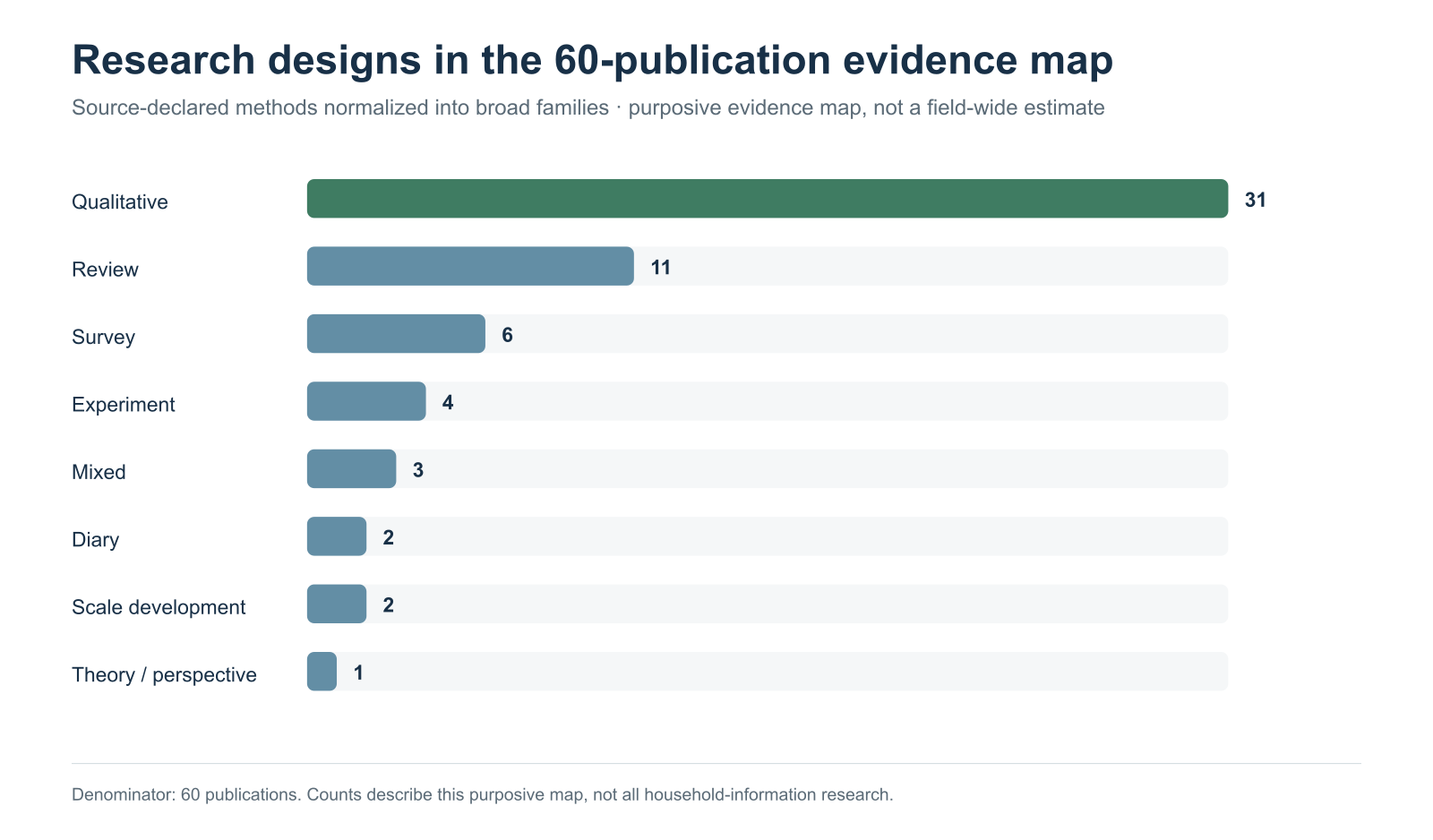
Figure 1. Source-declared study designs normalized into broad families across the 60-publication purposive evidence map.
Methods: a two-layer audit
The audit separates breadth from methodological detail and inherits its discovery boundary from the versioned household-information evidence map on which it is based.
Discovery and selection
The evidence-map layer contains 60 academic publications spanning 1991–2026. Discovery combined database searching, DOI and bibliographic verification, and backward and forward citation chasing from anchor papers across family information management, calendars, cognitive labor, household finance, personal health information, transactive memory, cognitive offloading, personal information management, errands, and household chaos. The map is purposive: it connects research areas relevant to the measurement problem rather than attempting exhaustive coverage of every database or discipline.
For every publication, the map preserves the source-declared study design, sample or scope, publication source, literature cluster, and evidence basis. Broad design families were normalized for comparison while the original method description remains available in the public data. The underlying map designated 24 papers as a core set because they directly examined household information work or supplied an adjacent mechanism or construct boundary needed for interpretation. The detailed methods layer was limited to the 19 core papers whose exact full text could be verified from a publisher, university, research institution, or author archive; five partial records were excluded from detailed coding.
Coding and consistency review
The verified methods layer contains 19 papers whose exact full text was reviewed. These papers were coded across 29 fields, including data source, temporal design, participation structure, artifact inspection, direct behavioral observation, system traces, cross-medium evidence, handoffs, access asymmetry, version conflict, responsibility disagreement, outcome measurement, and the level of work the method can make visible.
The field definitions were stress-tested on an eight-paper pilot chosen to maximize variation in design, unit of analysis, evidence relation, data source, and observability. The 29-field codebook was then frozen before the remaining core papers were coded. A second pass reviewed each observability field horizontally across all records and corrected one responsibility-disagreement classification. This was one structured coding workflow with a consistency pass, not independent double coding; no inter-rater reliability statistic is claimed.
Five of the 19 full-text-verified papers are reviews. Reviews analyze publications rather than household behavior, so their observability fields are coded as not applicable. The detailed observability results therefore use 14 primary-study papers as their denominator. Descriptive counts were generated directly from the versioned CSV; no significance tests were performed because the corpus is purposive.
Evidence and source boundary
Only exact scholarly papers and academic metadata were eligible. Product pages, competitor materials, market reports, user reviews, internal customer data, copyrighted full text, and proprietary scale items were excluded. Abstract-or-metadata records support bibliographic and broad design-family fields only; all 29 detailed fields require verified full text. The distribution should therefore be read as a description of this evidence map, not as a field-wide estimate.
Contextual methods dominate this evidence map
Qualitative research is the largest design family in the 60-publication evidence map. In the full-text-verified layer, interviews appear in 11 papers and artifact walkthroughs or comparable inspections appear in 10. This pairing is well suited to domestic information work because many important arrangements are tacit, spatial, and difficult to enumerate in advance.

AI-generated editorial scene: household information becomes observable through the artifacts and media used in ordinary routines. It depicts no study participant and is not research evidence.
For example, McKenzie used extended interviews grounded in the documents and objects participants used to keep track of everyday life. Neustaedter, Brush, and Greenberg asked family members to discuss real calendars and coordination artifacts. Moen and Brennan combined household health-information interviews with photographs of the artifacts participants used. Vyas and colleagues examined financial arrangements through in-home interviews, money-flow diagrams, and images of physical and digital systems.
These methods reveal relationships that a conventional questionnaire may miss: why a bill is placed in one location rather than another; why a paper calendar remains authoritative even when digital calendars exist; how a folder, list, or spreadsheet acquires meaning within a family routine; or how one member becomes the practical information manager.
Their strength is context. Their corresponding limit is reconstruction. An interview and a static artifact can establish that a transfer is part of the practice without recording the exact moment the transfer occurred.
An artifact is not a trace
Artifacts matter because they reduce reliance on memory and connect participant explanations to observable objects. Ten of the 14 verified primary-study papers examined naturally occurring artifacts such as calendars, lists, folders, screenshots, financial records, medication lists, or health documents.
But artifacts and traces answer different questions.
A photographed calendar shows a state: what was recorded, how it was arranged, and perhaps who could see it. A series of timestamped edits can show a process: when an event was entered, changed, duplicated, or deleted. A screenshot of several digital folders can demonstrate fragmentation at one moment, but it is not an interaction log.
This distinction changes the claims a study can make. Bergman, Beyth-Marom, and Nachmias combined interviews, screen captures, and a questionnaire to examine how personal project information was divided among document, email, and bookmark hierarchies. The screenshots strengthened the account of information state. They did not reconstruct every move between those systems.
None of the 14 primary-study papers in the full-text-verified layer analyzed system event logs or comparable traces. This does not mean trace-based research is absent from every neighboring literature. It means that it is absent from this selected household-information core, despite questions—handoff timing, duplicate entry, version changes, and completion monitoring—that traces could help address.
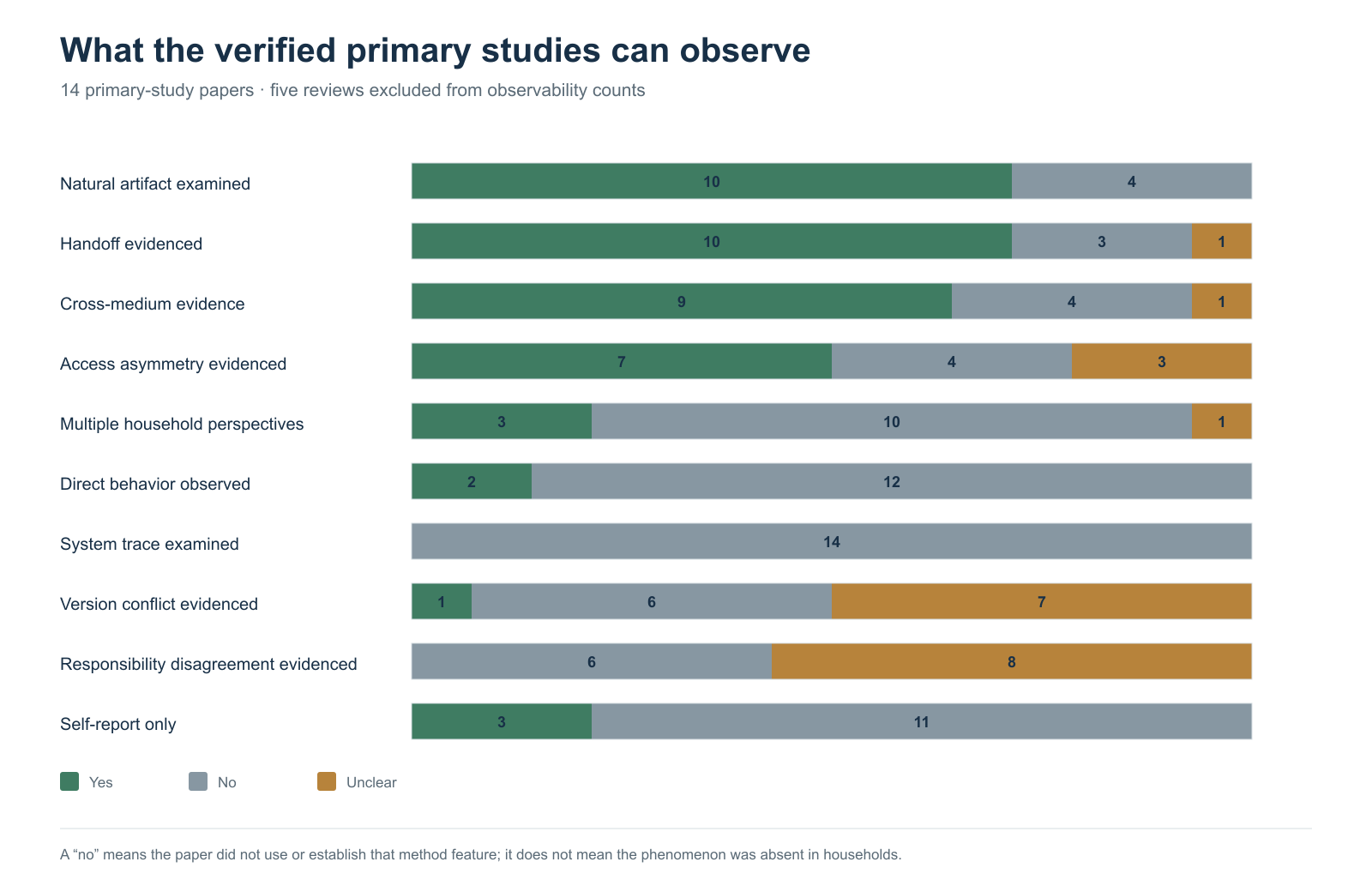
Figure 2. What the verified primary studies can observe. A “no” means that a paper's method did not use or establish that feature; it does not mean the phenomenon was absent in households.
A household is often represented by one member
Research can be about a household without collecting household-level perspectives.
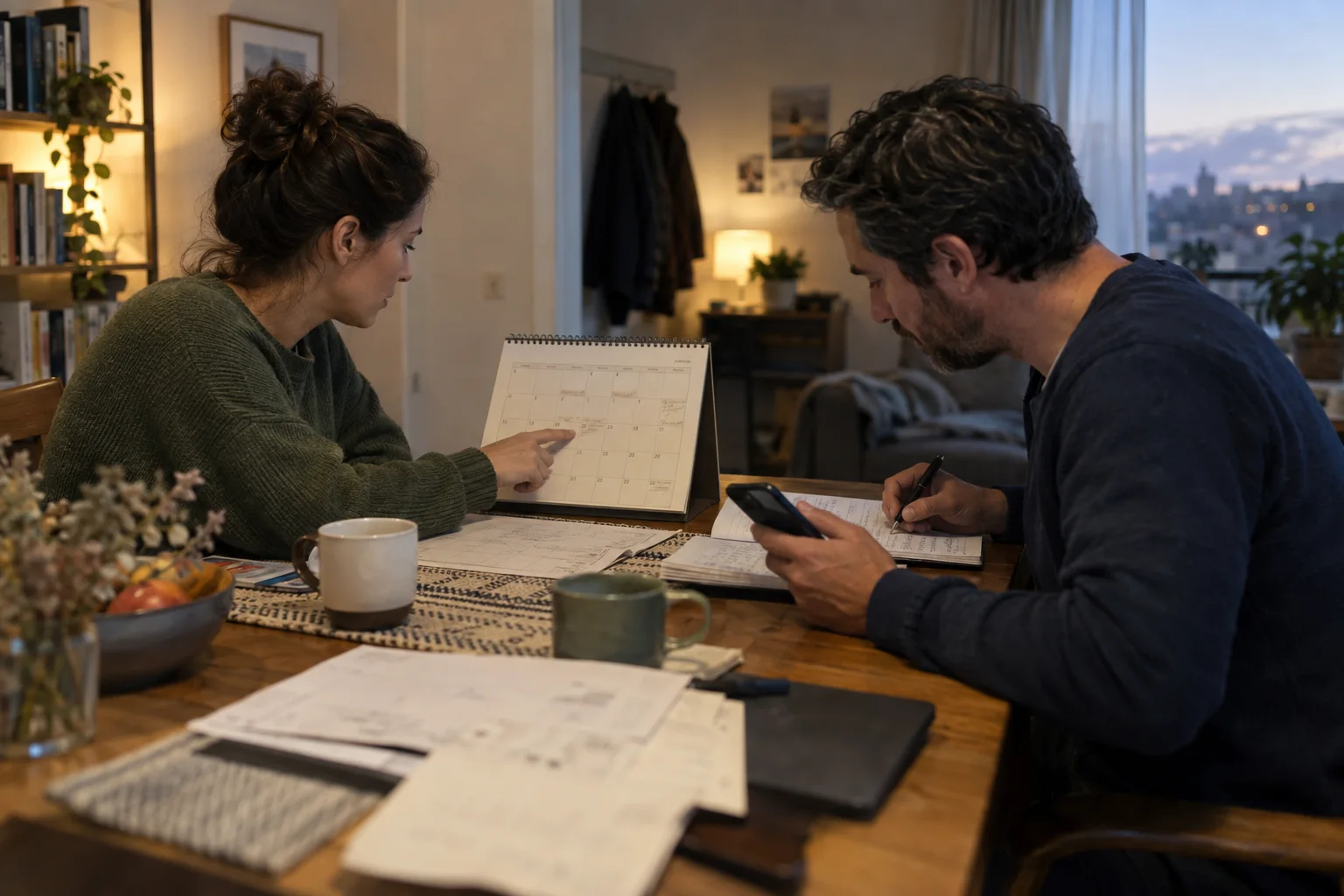
AI-generated editorial scene: studying agreement requires preserving each member's perspective, not only asking one person to describe the household. It depicts no study participant and is not research evidence.
Ten of the 14 verified primary-study papers did not retain data from multiple members of the same household or couple. Three did, and one was unclear under our coding threshold. A person describing what a partner does still counts as single-perspective evidence.
This distinction matters most when the research question involves agreement or responsibility. A single participant may accurately describe the household's routine, but the method cannot determine whether another member would describe the same allocation, recognize the same information source, or agree about who is responsible for monitoring completion.
Even studies with several participants require care. In the family-calendar study by Neustaedter and colleagues, 60 individuals represented 44 family cases, but participation varied: many interviews involved only the primary scheduler, while a smaller subset included two parents or several family members. The study offers unusually rich household evidence, yet not every case contains equivalent member coverage.
Similarly, Ancker and colleagues interviewed both patients and health care providers, but the providers were not recruited as matched household members. Multiple stakeholder groups should not be mislabeled as multiple household perspectives.
Handoffs are commonly represented; failure points are rarely reconstructed
Ten primary studies contained evidence that information, tasks, requests, or responsibility passed between people or systems. In-home studies describe manual copying between paper notices, calendars, email, portals, and interpersonal reminders. Diary research records requests and offers between household members. Health-information research shows patients carrying records among organizations.
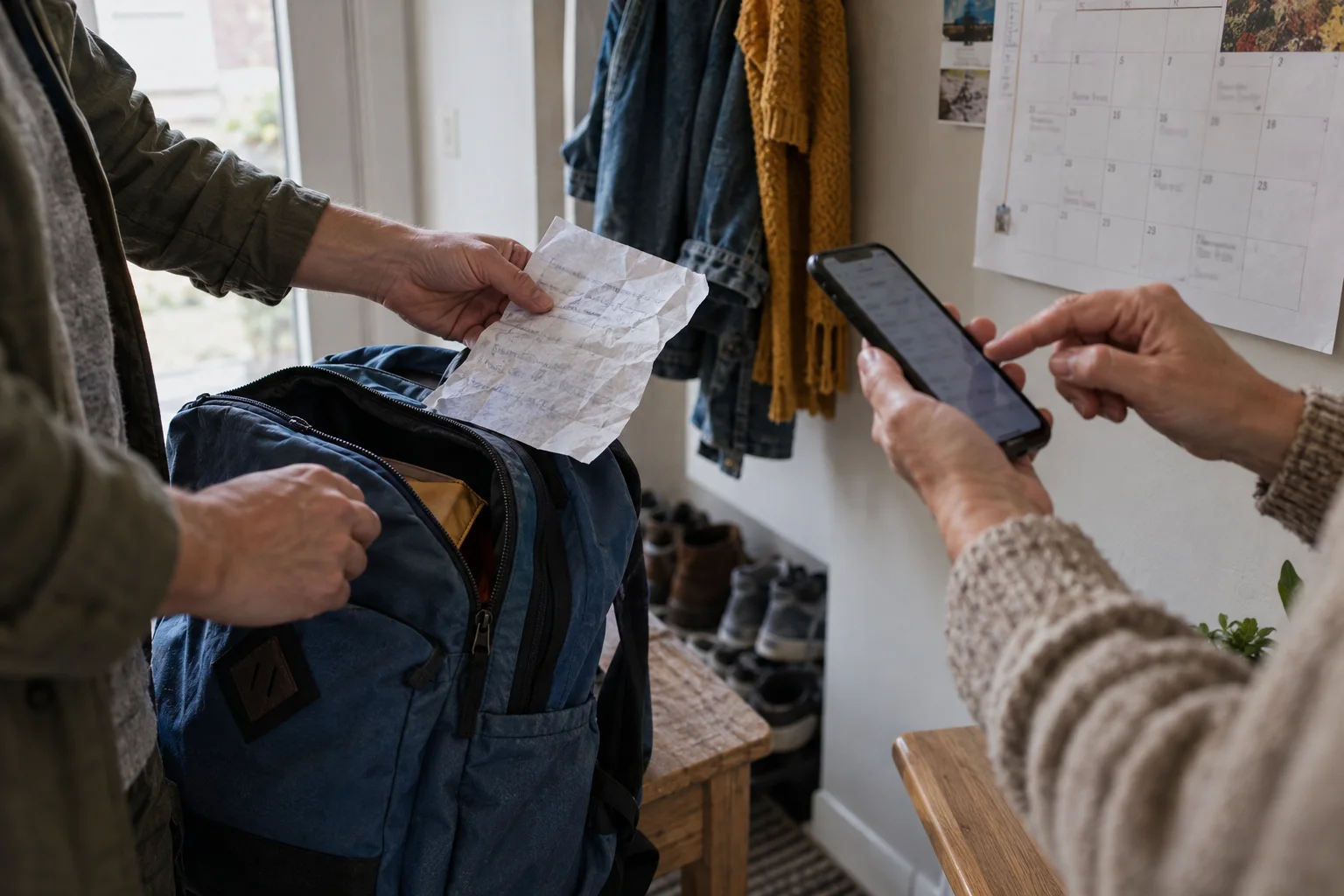
AI-generated editorial scene: one handoff can cross a person, a paper artifact, a phone, and a calendar. It depicts no study participant and is not research evidence.
Yet only two papers directly observed behavior or task performance. Most handoff evidence comes from interviews, participant-entered diaries, and artifact walkthroughs. Those sources can establish that handoffs occur and explain how participants understand them. They usually cannot reconstruct every transition or identify the precise point at which information became outdated, inaccessible, or detached from responsibility.
The difference is especially clear in version coding. One primary study met the threshold for direct evidence of version conflict; seven were unclear. Ancker and colleagues documented participants discovering incorrect or missing medical information and undertaking work to correct it. Elsewhere, multiple storage locations, duplicated calendars, or manual copying suggested opportunities for conflict but did not necessarily demonstrate that two incompatible versions existed.
Multiple copies are not automatically a version conflict. A study must identify an outdated, contradictory, duplicated, or reconciled state to support that claim.
Allocation is not agreement
Responsibility is frequently part of household-information research. Studies identify primary schedulers, household information managers, divisions of expertise, or people who usually perform a coordination task.
But measuring allocation is different from measuring disagreement about allocation.
During our second-pass audit, we changed one record that had initially been coded as evidencing responsibility disagreement. The paper clearly distinguished primary and secondary scheduler roles. It did not establish that members held conflicting beliefs about those roles or disputed who was responsible.
After applying the stricter rule across the verified layer, no primary-study paper met the threshold for responsibility_disagreement_observed=yes. Eight remained unclear because the design could not compare separately collected member perspectives, and six did not measure disagreement.
This is a measurement gap, not evidence that households agree. A study designed to test agreement would need separately collected, linkable data from multiple members, with responsibility measured at the same level of task or information object.
Methods reveal different layers of work
We coded four forms of method visibility:
- Process: sequence, transition, coordination, or work over time.
- State: arrangement, distribution, inventory, or condition at a point.
- Outcome: consequence, completion, error, wellbeing, or another result.
- Mechanism: an experimentally manipulated or theoretically modeled operation.
Interviews and artifact walkthroughs most often supported process and state claims in the verified core. Reviews frequently synthesized outcomes. Experiments provided the clearest mechanism evidence but used controlled tasks that did not reproduce everyday household information environments.
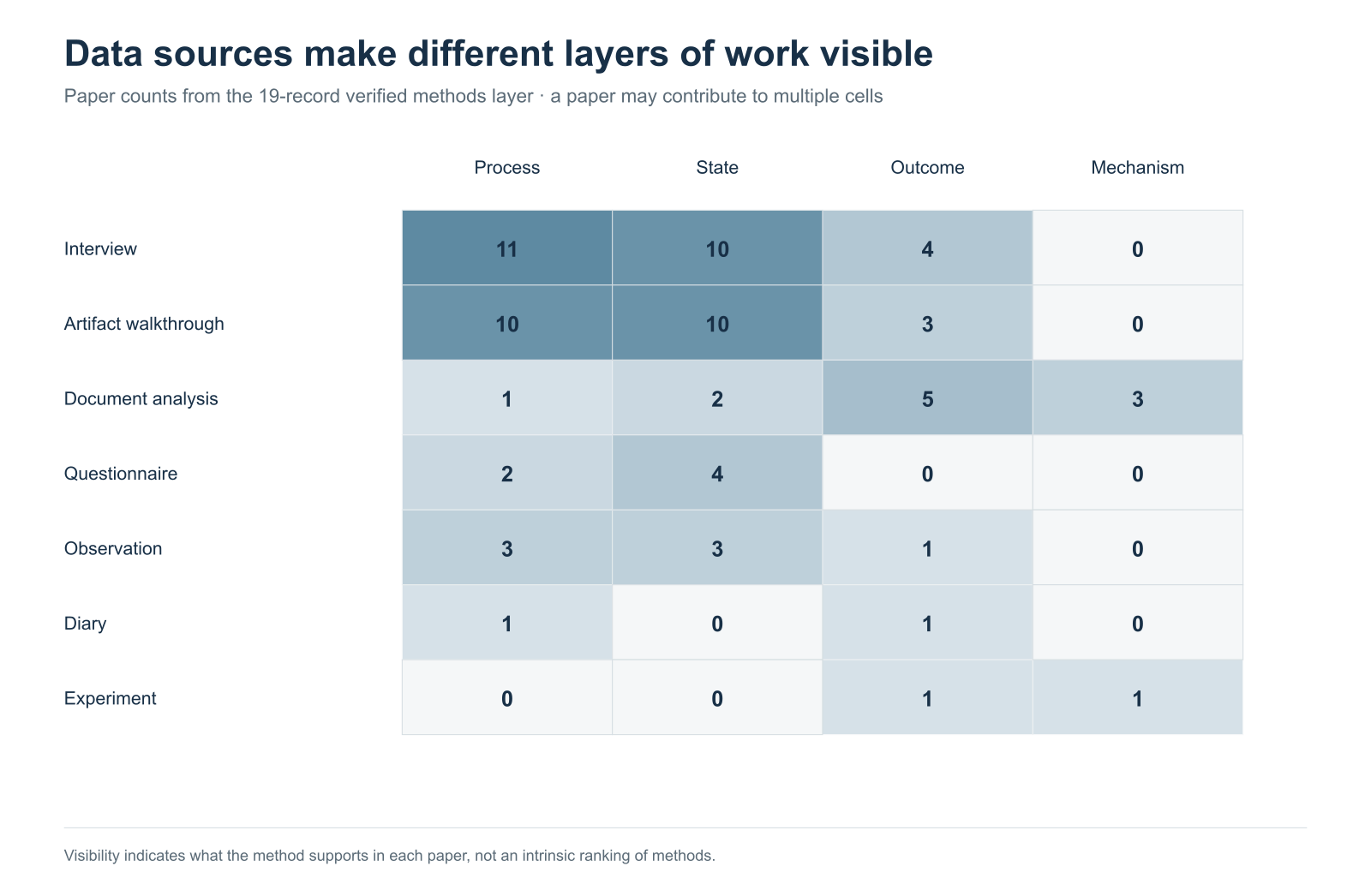
Figure 3. Data source by method visibility in 19 verified papers. A paper may contribute to several cells; the figure is not a ranking of methods.
The implication is not that one method should replace the others. Different claims need different evidence. A carefully conducted interview can explain meaning and practice better than an event log. A trace can reconstruct timing more reliably than retrospective recall. A dyadic experiment can isolate a mechanism while still saying little about paper forms, school portals, care instructions, or the social consequences of missed obligations.
Choose the method from the claim
Research design becomes clearer when the desired conclusion is stated first.
If the question is what tools and arrangements exist, interviews plus artifact walkthroughs provide contextual and material evidence. If the question is how work unfolds, direct observation or an event-level diary adds temporal resolution. If the question is where a handoff fails, process tracing and ethically collected timestamps are needed. If the question is whether members agree about responsibility, data must be collected separately from multiple members and linked at the same unit of work. If the question is which version was current, researchers need artifact history or system traces rather than a single static copy.
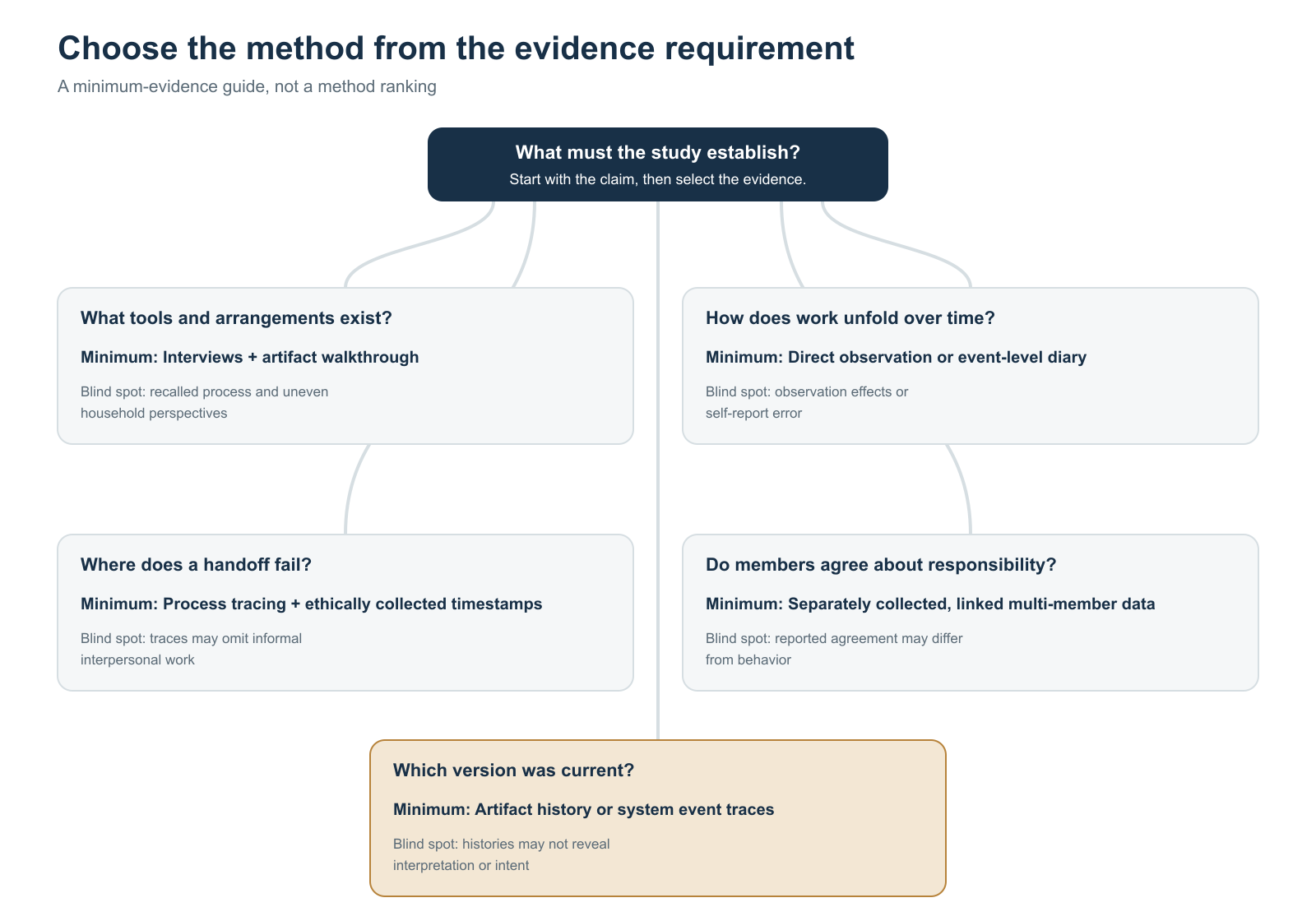
Figure 4. Choose the method from the evidence requirement. The tree identifies minimum evidence and a principal blind spot; it does not rank methods.
A minimum reporting checklist
The audit suggests a compact reporting checklist for future household-information studies. It is not a validated standard or consensus guideline.
Researchers should report:
- the unit of analysis;
- which household members actually contributed data;
- the information object, obligation, or task being studied;
- the media and systems involved;
- the observation window;
- the lifecycle stages included;
- whether handoffs, access differences, and version history were observed or only reported;
- whether responsibility was self-reported, negotiated, compared across members, or behaviorally observed;
- the source of each outcome measure; and
- the conclusion the method cannot support.
Reporting these elements would make evidence easier to compare across family studies, information science, HCI, health informatics, memory research, and household-labor research without forcing those fields into one theoretical vocabulary.
Limitations
This audit has five important limits.
First, the 60-publication map is purposive. It connects relevant literatures but is not a systematic review or exhaustive search of every database or discipline. Second, detailed coding is limited to 19 core papers with verifiable accessible full text, creating a potential availability bias. Third, the coding was performed in one structured workflow with a second horizontal consistency pass; it is not independent double coding, and no inter-rater reliability statistic is claimed. Fourth, some constructs required conservative coding because papers did not report enough methodological detail. Fifth, this audit describes measurement coverage, not the prevalence or severity of household information problems.
Data availability and reproducibility
The versioned research package contains:
- the 60-publication evidence-map dataset;
- the 19-paper full-text methods coding;
- the 29-field codebook;
- the second-pass consistency audit;
- the base-map search log;
- the source policy;
- the full-text verification log;
- the data validator; and
- the figure generator.
The package contains original bibliographic metadata and coding decisions, not copyrighted paper text or scale items. Original article text, data, codebook, and figures are released under CC BY 4.0; the validation and figure-generation scripts are released under the MIT License. Corrections should receive a new dated version rather than silently changing Version 1.0.
Only academic papers and exact copies hosted by publishers, universities, research institutions, or authors were used to verify claims. Product pages, competitor materials, market reports, user reviews, and internal customer data were excluded.
The three documentary-style photographs and the cover are AI-generated editorial illustrations. They depict no study participant or actual research session and are not part of the evidence base.
Disclosure
Kinmory Research is affiliated with the development of household information software. To reduce product-driven interpretation, the public evidence boundary excludes product comparisons, feature recommendations, integration priorities, and claims that a particular software system solves the measurement gaps identified here.
The purpose of this audit is narrower: to help researchers match household-information claims to methods capable of supporting them.
Frequently asked questions
What is household information work?
Household information work is the activity required to receive, interpret, allocate, store, transfer, retrieve, act on, and monitor information used in everyday household coordination.
What did this methods audit examine?
The audit mapped 60 publications across connected research areas and applied a frozen 29-field codebook to 19 full-text-verified core papers. Its purpose is to identify what different methods make visible, not to estimate prevalence or rank research quality.
Why is an artifact not the same as a trace?
An artifact such as a calendar, list, or screenshot shows an information state. A trace such as timestamped edits or event logs can reconstruct a process over time. Each supports different claims.
Why do multiple household perspectives matter?
One member can accurately describe a routine, but their account cannot establish whether another member recognizes the same information source or agrees about responsibility. Agreement claims require separately collected, linkable data from multiple members.
Can researchers reuse the data and codebook?
Yes. The versioned datasets, codebook, audit logs, figures, and article text are available under the stated open licenses. The package contains original metadata and coding decisions, not copyrighted paper text or proprietary scale items.
References
The following 19 publications constitute the full-text-verified core coded in the detailed methods layer. The complete 60-publication bibliography is available in the evidence-map dataset.
Ancker, J. S., Witteman, H. O., Hafeez, B., Provencher, T., Van de Graaf, M., & Wei, E. (2015). The invisible work of personal health information management among people with multiple chronic conditions: Qualitative interview study among patients and providers. *Journal of Medical Internet Research, 17*(6), e137. https://doi.org/10.2196/jmir.4381
Bergman, O., Beyth-Marom, R., & Nachmias, R. (2006). The project fragmentation problem in personal information management. *Proceedings of the SIGCHI Conference on Human Factors in Computing Systems*, 271–274. https://doi.org/10.1145/1124772.1124813
Eschler, J., Kendall, L., O’Leary, K., Vizer, L. M., Lozano, P., McClure, J. B., Pratt, W., & Ralston, J. D. (2015). Shared calendars for home health management. *Proceedings of the 18th ACM Conference on Computer Supported Cooperative Work & Social Computing*, 1277–1288. https://doi.org/10.1145/2675133.2675168
Frampton, S. L., Gould, S. J. J., & Cox, A. L. (2026). The domestic operating system: An empirical investigation of digital technology and hidden work in the home. *Proceedings of the 2026 CHI Conference on Human Factors in Computing Systems*, 1–22. https://doi.org/10.1145/3772318.3791167
Gilbert, S. J., Boldt, A., Sachdeva, C., Scarampi, C., & Tsai, P.-C. (2022). Outsourcing memory to external tools: A review of intention offloading. *Psychonomic Bulletin & Review, 30*(1), 60–76. https://doi.org/10.3758/s13423-022-02139-4
Grimes, A., & Brush, A. J. (2008). Life scheduling to support multiple social roles. *Proceedings of the SIGCHI Conference on Human Factors in Computing Systems*, 821–824. https://doi.org/10.1145/1357054.1357184
Harris, C. B., Barnier, A. J., Sutton, J., & Keil, P. G. (2014). Couples as socially distributed cognitive systems: Remembering in everyday social and material contexts. *Memory Studies, 7*(3), 285–297. https://doi.org/10.1177/1750698014530619
Hewitt, L. Y., & Roberts, L. D. (2015). Transactive memory systems scale for couples: Development and validation. *Frontiers in Psychology, 6*, 516. https://doi.org/10.3389/fpsyg.2015.00516
Marsh, S., Dobson, R., & Maddison, R. (2020). The relationship between household chaos and child, parent, and family outcomes: A systematic scoping review. *BMC Public Health, 20*, 513. https://doi.org/10.1186/s12889-020-08587-8
McKenzie, P. J. (2021). Keeping track of family: Family practices and information practices. *Library Trends, 70*(2), 78–104. https://doi.org/10.1353/lib.2021.0016
Moen, A., & Brennan, P. F. (2005). Health@Home: The work of health information management in the household: Implications for consumer health informatics innovations. *Journal of the American Medical Informatics Association, 12*(6), 648–656. https://doi.org/10.1197/jamia.M1758
Neustaedter, C., Brush, A. J. B., & Greenberg, S. (2009). The calendar is crucial: Coordination and awareness through the family calendar. *ACM Transactions on Computer-Human Interaction, 16*(1), 1–48. https://doi.org/10.1145/1502800.1502806
Reich-Stiebert, N., Froehlich, L., & Voltmer, J.-B. (2023). Gendered mental labor: A systematic literature review on the cognitive dimension of unpaid work within the household and childcare. *Sex Roles, 88*(11–12), 475–494. https://doi.org/10.1007/s11199-023-01362-0
Risko, E. F., & Gilbert, S. J. (2016). Cognitive offloading. *Trends in Cognitive Sciences, 20*(9), 676–688. https://doi.org/10.1016/j.tics.2016.07.002
Sannon, S., Vorvoreanu, M., Walker, K., & Fourney, A. (2020). “Am I doing this all wrong?” Challenges and opportunities in family information management. *Proceedings of the ACM on Human-Computer Interaction, 4*(CSCW2), 1–28. https://doi.org/10.1145/3415209
Sohn, T., Lee, L., Zhang, S., Dearman, D., & Truong, K. N. (2012). An examination of how households share and coordinate the completion of errands. *Proceedings of the ACM 2012 Conference on Computer Supported Cooperative Work*, 729–738. https://doi.org/10.1145/2145204.2145315
Taylor, A. S., & Swan, L. (2004). List making in the home. *Proceedings of the 2004 ACM Conference on Computer Supported Cooperative Work*, 542–545. https://doi.org/10.1145/1031607.1031697
Vyas, D., Snow, S., Roe, P., & Brereton, M. (2016). Social organization of household finance. *Proceedings of the 19th ACM Conference on Computer-Supported Cooperative Work & Social Computing*, 1777–1789. https://doi.org/10.1145/2818048.2819937
Wegner, D. M., Erber, R., & Raymond, P. (1991). Transactive memory in close relationships. *Journal of Personality and Social Psychology, 61*(6), 923–929. https://doi.org/10.1037/0022-3514.61.6.923
Related reading
- The Missing Map of Household Information
A structured evidence map of how families receive, interpret, allocate, store, transfer, retrieve, act on, and monitor everyday information.
- Meet Kinmory AI Recipes: Create, Import, Personalize, and Share
Discover AI Recipes in Kinmory, the family organization and planning app. Create recipes with AI, import from the web, personalize, and share.
- Where's the Wi-Fi Password? The Facts One Parent Holds
The wifi password, the allergies, the plumber's name: the household facts that quietly live in one parent's head — and how to move them off it.
- What Is Transactive Memory? How Families Share Knowledge
A research-grounded guide to transactive memory: its definition, evidence from couples, limits, and what it may explain about family mental load.
Bring your family's plans into one place.
Use Kinmory on the web or phone to share calendars, tasks, meals and the information your household needs next.

Scan to Download
Point your camera here
kinmory.ai/download/kinmory