
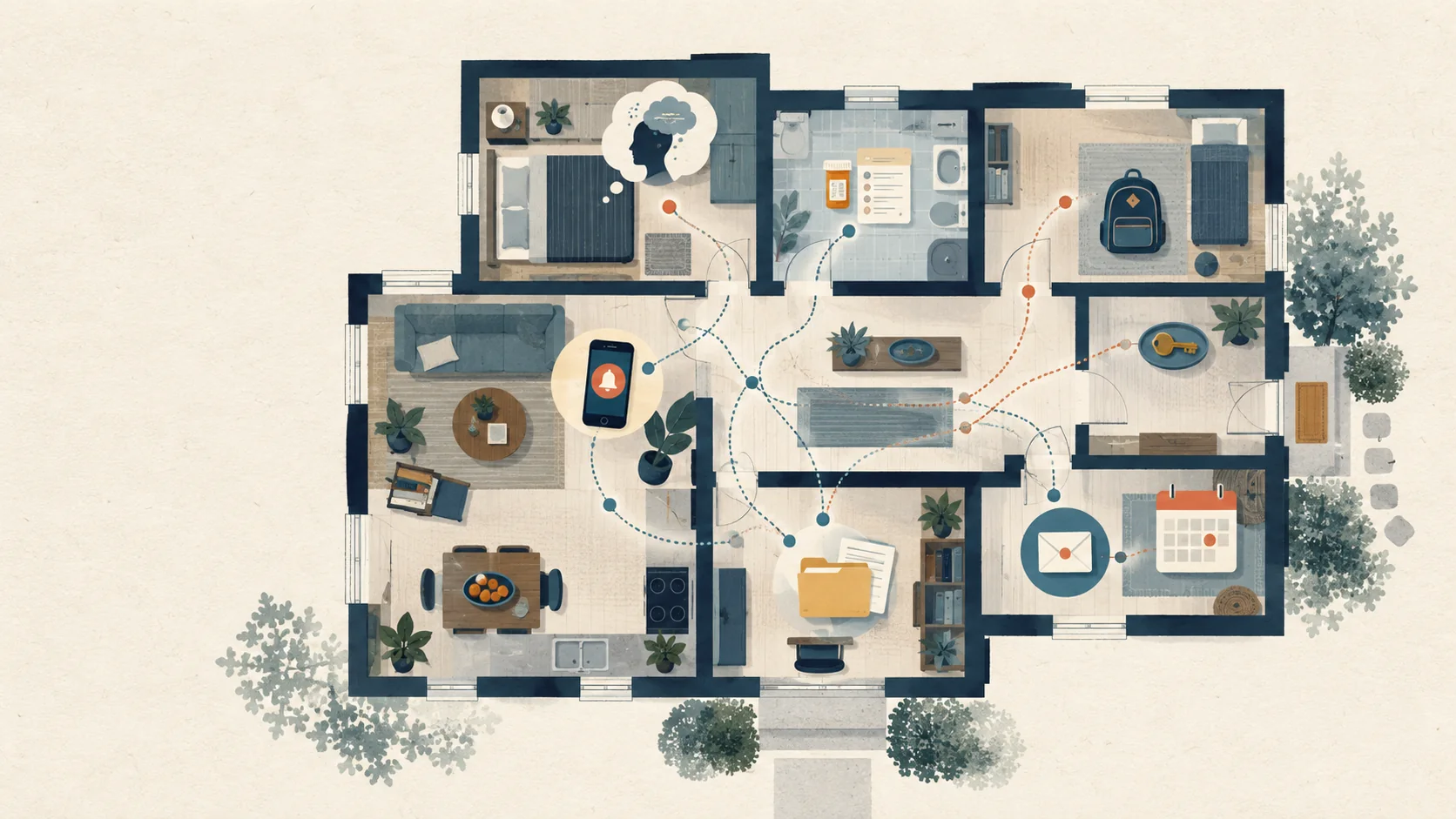
The Missing Map of Household Information
A structured evidence map of how families receive, interpret, allocate, store, transfer, retrieve, act on, and monitor everyday information.
Structured evidence map · Version 1.0
Abstract
Household coordination depends on information distributed across people, paper, messages, files, accounts, calendars, institutions, and memory. Relevant research exists across sociology, cognitive psychology, information science, health informatics, and human–computer interaction, but these fields use different constructs and units of analysis. This structured evidence map brings 60 academic records across 16 literature clusters into a common information lifecycle. Twenty-four core papers were coded in depth, and 19 were verified against full text. The synthesis distinguishes five mechanisms—source, storage, access, transfer, and responsibility fragmentation—and separates direct household evidence from adjacent constructs, non-household mechanisms, and conceptual boundaries. Verified studies most frequently covered storage and retrieval, while receipt and interpretation were least represented. The literature supports a map of observable mechanisms, but not a validated fragmentation scale, population prevalence estimate, universal relationship with household outcomes, or proven technological remedy. The resulting framework is intended to support more precise observational research on how information becomes household action.
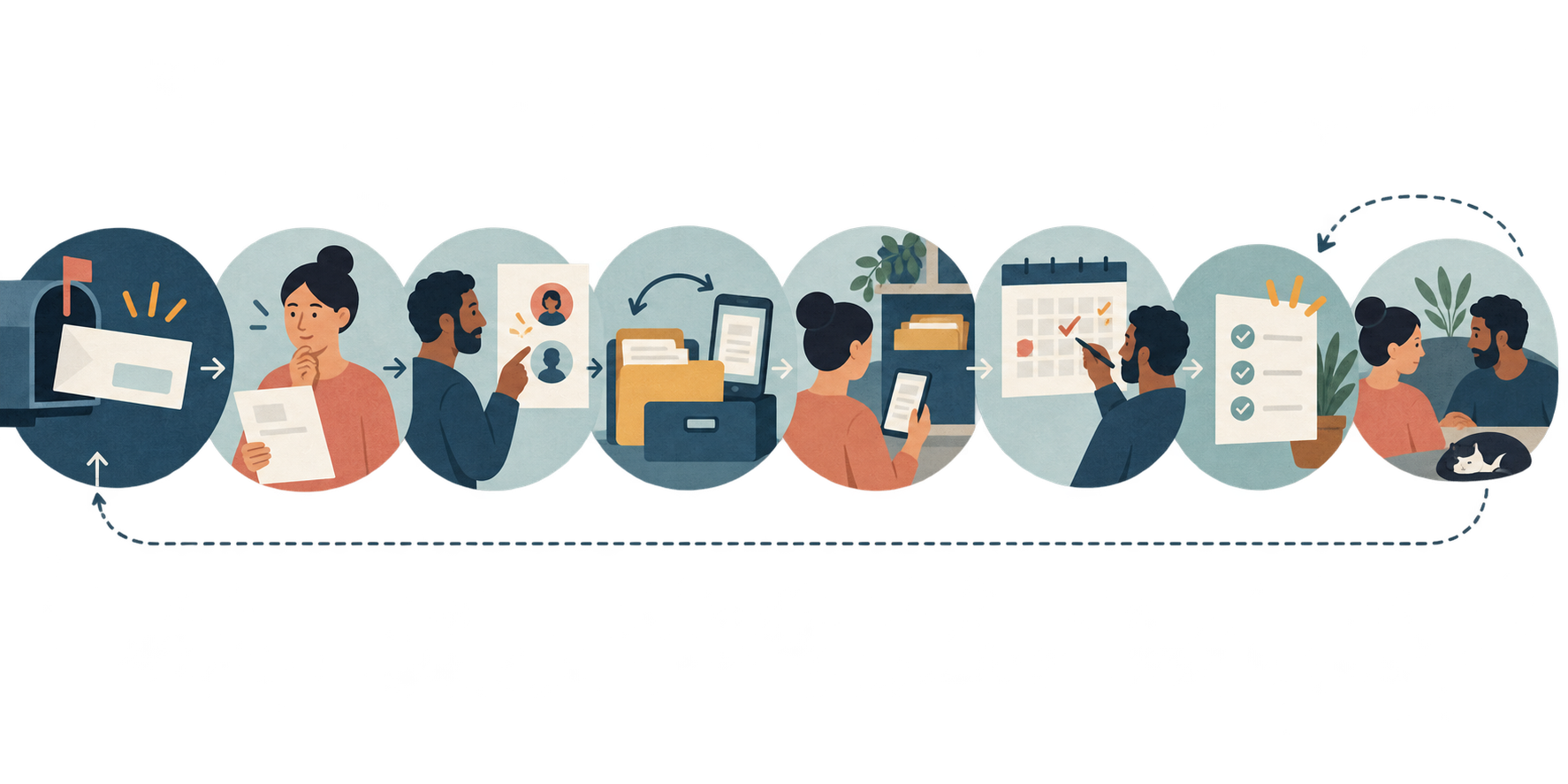
A school sends an email about an upcoming trip. The deadline is inside a PDF attachment. One parent notices a correction in a group message. The other copies the event into a work calendar. A paper form still needs a signature and must return in a backpack.
This is a synthetic example, not a report about a particular family. It illustrates a structure that appears in several research traditions: the information needed to coordinate household life may be divided across sources, storage locations, access rights, transfer steps, and people’s responsibilities.
Researchers have studied many parts of this problem. Sociology examines the cognitive work of anticipating and monitoring household needs. Cognitive psychology studies how couples divide memory and how people move intentions into external tools. Information science studies keeping, finding, and maintaining information. Human–computer interaction studies family calendars, lists, finances, health records, and caregiving handoffs.
These fields rarely use the same vocabulary. As a result, evidence about one information journey is distributed across several literatures—much like the household information being studied.
This evidence map brings those literatures into a common frame. It does not propose a validated scale, estimate how common fragmentation is, or evaluate any product. Its narrower purpose is to show what researchers have directly observed, what they have only studied in adjacent settings, and where the connections remain untested.

A working definition
We use household information fragmentation to describe a condition in which information required for everyday household coordination is distributed across multiple sources, media, accounts, people, or moments in time, creating the possibility of repeated entry, manual transfer, retrieval failure, inconsistent versions, unclear responsibility, or missed action.
The definition concerns information structure and movement. It is not a diagnosis of whether a household is organized, whether a person is good at planning, or whether a particular tool is effective.
The evidence suggests five analytically distinct mechanisms:
- Source fragmentation: relevant information enters through different institutions, people, and communication channels.
- Storage fragmentation: related information is kept in separate places such as email, documents, bookmarks, paper, calendars, or memory.
- Access fragmentation: household members can see or change different parts of the information environment.
- Transfer fragmentation: information must be copied, re-entered, forwarded, or retold as it moves between people or systems.
- Responsibility fragmentation: knowing, interpreting, recording, checking, and acting are distributed across household members, sometimes without a shared understanding of who owns each step.
These mechanisms form an evidence-mapping framework, not a validated latent construct. A household may experience one mechanism without the others, and fragmentation is not necessarily harmful in every context.
Key findings
- Fragmentation is not synonymous with using several tools. It can arise at the source, storage, access, transfer, or responsibility layer.
- Eleven full-text-verified core papers provide direct evidence about household information flow. The remaining verified papers supply adjacent constructs, general mechanisms, or a boundary comparison.
- Direct studies document mixed paper–digital–interpersonal systems, manual information transfer, locally meaningful workarounds, and responsibility distributed across household members.
- Across the verified core set, storage and retrieval each appeared in 14 papers; receipt and interpretation each appeared in 6.
- The evidence does not establish that additional channels cause worse outcomes, that the five mechanisms form a single scale, or that one technical intervention will resolve them.
One problem, several research traditions
Cognitive labor: who performs the integration work?
Research on household cognitive labor focuses on activities that precede visible action: anticipating needs, identifying options, making decisions, and monitoring results. A systematic review of gendered mental labor shows that this work is often studied through responsibility, workload, and relationship outcomes rather than through the locations or formats of information itself (Reich-Stiebert, Froehlich, and Voltmer, 2023).
This literature helps explain who bears the cost of repairing fragmented information. It does not establish that fragmentation causes unequal cognitive labor. A household could have concentrated information and unequal responsibility, or dispersed information and well-coordinated responsibility.
Transactive memory: people are information locations too
Couples can develop a division of remembering in which each person learns what the other is likely to know. In a controlled experiment with 118 people in close relationships, established couples performed differently from newly paired participants depending on whether an external memory structure was imposed (Wegner, Erber, and Raymond, 1991). Later work developed measures of specialization, credibility, and coordination in couples’ transactive memory systems (Hewitt and Roberts, 2015).
A review of four studies with intimate couples further shows that remembering can be distributed across both interpersonal and material resources (Harris et al., 2014).
This matters because a person may function as a household information node. But specialization is not automatically fragmentation. A well-coordinated division of knowledge can be efficient. The risk emerges when household members lack accurate knowledge of where information resides, cannot access it when needed, or disagree about responsibility.
Cognitive offloading: why information moves into tools
People routinely reduce cognitive demand by changing their environment: writing something down, setting a reminder, or storing information on a device. Reviews of cognitive and intention offloading describe both the benefits and the tradeoffs of externalizing memory (Risko and Gilbert, 2016; Gilbert et al., 2022).
Offloading can improve the completion of delayed intentions, but it also changes what must be remembered. Instead of remembering the content, a person may need to remember where the content was stored and whether the external cue will be available.
These studies provide a plausible cognitive mechanism for household reminders, lists, and calendars. Most of the underlying evidence is not household research, however. It should not be used to claim that adding or removing a household tool will produce a particular outcome.
Personal information management: fragmentation across formats
Personal information management research supplies mature language for keeping, organizing, finding, and maintaining information. One especially relevant study defines a project-fragmentation problem: documents, email, and web bookmarks related to the same project can be separated because applications organize information by format. Interviews, screen captures, and a questionnaire with 20 computer users showed that interface structure influenced whether related items were kept together or split across collections (Bergman, Beyth-Marom, and Nachmias, 2006).
This is direct evidence of storage fragmentation, but not within households. Applying the mechanism to family life is a cross-context inference that requires support from household studies.
Family information management: the closest direct literature
Family information management research examines how households handle information as part of everyday coordination. Interviews and archive tours with ten families documented challenges spanning the full lifecycle from receiving and interpreting information to storing, sharing, retrieving, acting, and monitoring (Sannon et al., 2020).
Information practices also participate in creating and maintaining family relationships. Interviews with 47 participants identified practices of keeping track of family, for family, and with family, using calendars, lists, messages, and interpersonal monitoring (McKenzie, 2021).
Recent research on hidden work in the home adds a broader view of how digital technology supports—and sometimes becomes part of—family-management labor (Frampton, Gould, and Cox, 2026).
This literature is the strongest direct foundation for household information fragmentation. Even here, however, studies generally describe practices rather than test a single fragmentation construct.
Five mechanisms in the household evidence
1. Source fragmentation
Source fragmentation occurs before information is organized inside the household. Schools, workplaces, healthcare providers, relatives, and community organizations may each deliver information differently.
In a study of 15 working parents, participants showed researchers their work and family calendars and provided 1,474 calendar events for analysis. School and extracurricular information arrived through paper, email, and websites, while parents moved selected information into calendars used at work or home (Grimes and Brush, 2008).
The evidence map found that receiving information was one of the least frequently covered lifecycle stages. Researchers more often began with information that a household had already stored or was already trying to use. This means the field knows less about how external information first crosses the household boundary than about what happens afterward.
2. Storage fragmentation
Household information is not stored in one uniform system. Paper can remain valuable because it is visible, flexible, and situated in a shared place. Digital tools can be searchable, portable, and accessible from several settings. People also remember information on behalf of one another.
An ethnographic study involving interviews with eight mothers and observation in their homes found that paper lists organized relationships among people, activities, locations, and tasks. The same flexibility that made lists useful also made them poor at separating or classifying those elements (Taylor and Swan, 2004).
Research on household finance similarly found that families assembled physical and digital resources—including accounts, spreadsheets, diaries, online banking, and papers—into locally meaningful systems shaped by routines and relationships. The study used in-home interviews and flow-of-money mapping with 15 Australian families (Vyas et al., 2016).
Multiple storage locations are therefore not simply evidence of failure. Families may deliberately preserve several representations because each supports a different place, audience, or activity. The research question is not merely how many tools exist, but whether the resulting arrangement preserves findability, consistency, and continuity.
3. Access fragmentation
Shared household information does not imply equal access. One person may control an account, keep a calendar at work, carry the relevant paper, or understand an informal notation that others cannot interpret.
Family-calendar research with 44 families described several arrangements: some revolved around a central calendar, while others distributed awareness across multiple artifacts and people (Neustaedter, Brush, and Greenberg, 2009). These arrangements supported coordination in different ways; a single centralized calendar was not the only workable pattern.
Access problems become especially consequential in health and care settings. A human-factors model of household health-information work treats people, tasks, tools, and the home environment as an interacting system (Moen and Brennan, 2005). Studies of home health management and personal health information document information distributed across calendars, records, providers, patients, and caregivers (Eschler et al., 2015; Ancker et al., 2015).
These studies show that access is relational and contextual. The relevant question is often not whether information exists, but whether the right person can reach and understand the current version at the moment of action.
4. Transfer fragmentation
Whenever two systems or people do not share a common representation, someone must bridge the gap. Transfer can involve copying a date, forwarding a message, explaining a change, reconciling two records, or carrying a paper artifact between settings.
The working-parent calendar study provides a concrete example: participants moved personal and family appointments into workplace calendars because those calendars were more visible during the day and helped communicate availability. They also reported difficulty aggregating information arriving from school flyers, email, and websites (Grimes and Brush, 2008).
Home-health studies add evidence of manual reconciliation and redundancy across providers and records (Eschler et al., 2015; Ancker et al., 2015). These are domain-specific studies, but they directly show that information continuity may depend on work performed outside formal systems.
The present literature does not establish a general relationship between the number of transfers and household outcomes. Transfer count, transfer accuracy, and the identity of the person doing the transfer remain useful measurement candidates rather than proven universal predictors.
5. Responsibility fragmentation
Responsibility fragmentation concerns more than task assignment. Different household members may separately notice, interpret, record, remind, perform, and verify the same obligation.
A three-week diary study of eight households—three families and five roommate households—examined how people requested, offered, and completed errands. Coordination depended on awareness of other members’ errands, locations, availability, and capabilities (Sohn et al., 2012).
Household lists and financial systems also embedded responsibility in artifacts and routines (Taylor and Swan, 2004; Vyas et al., 2016). Cognitive-labor research explains why the work of anticipating and monitoring may remain invisible even when the visible action is shared (Reich-Stiebert, Froehlich, and Voltmer, 2023). Transactive-memory research explains how responsibility for remembering can become specialized between partners (Wegner, Erber, and Raymond, 1991).
Together, these literatures support responsibility as a central part of the map. They do not show that specialized responsibility is inherently harmful. The important distinction is between coordinated specialization and an arrangement in which ownership is ambiguous, inaccessible, or understood differently by household members.
Figure 1: coverage across the information lifecycle
The coded lifecycle has eight stages:
receive → interpret → allocate → store → transfer → retrieve → act → monitor
Among the 19 core papers whose full text was verified, the evidence map coded the following coverage:
| Lifecycle stage | Verified core papers covering the stage |
|---|---|
| Receive | 6 |
| Interpret | 6 |
| Allocate | 10 |
| Store | 14 |
| Transfer | 10 |
| Retrieve | 14 |
| Act | 12 |
| Monitor | 12 |
These values count papers, not households or observed events. A paper can cover several stages. The pattern suggests that existing research is richer on storage and retrieval than on initial receipt and interpretation. It does not estimate how often failures occur at any stage.
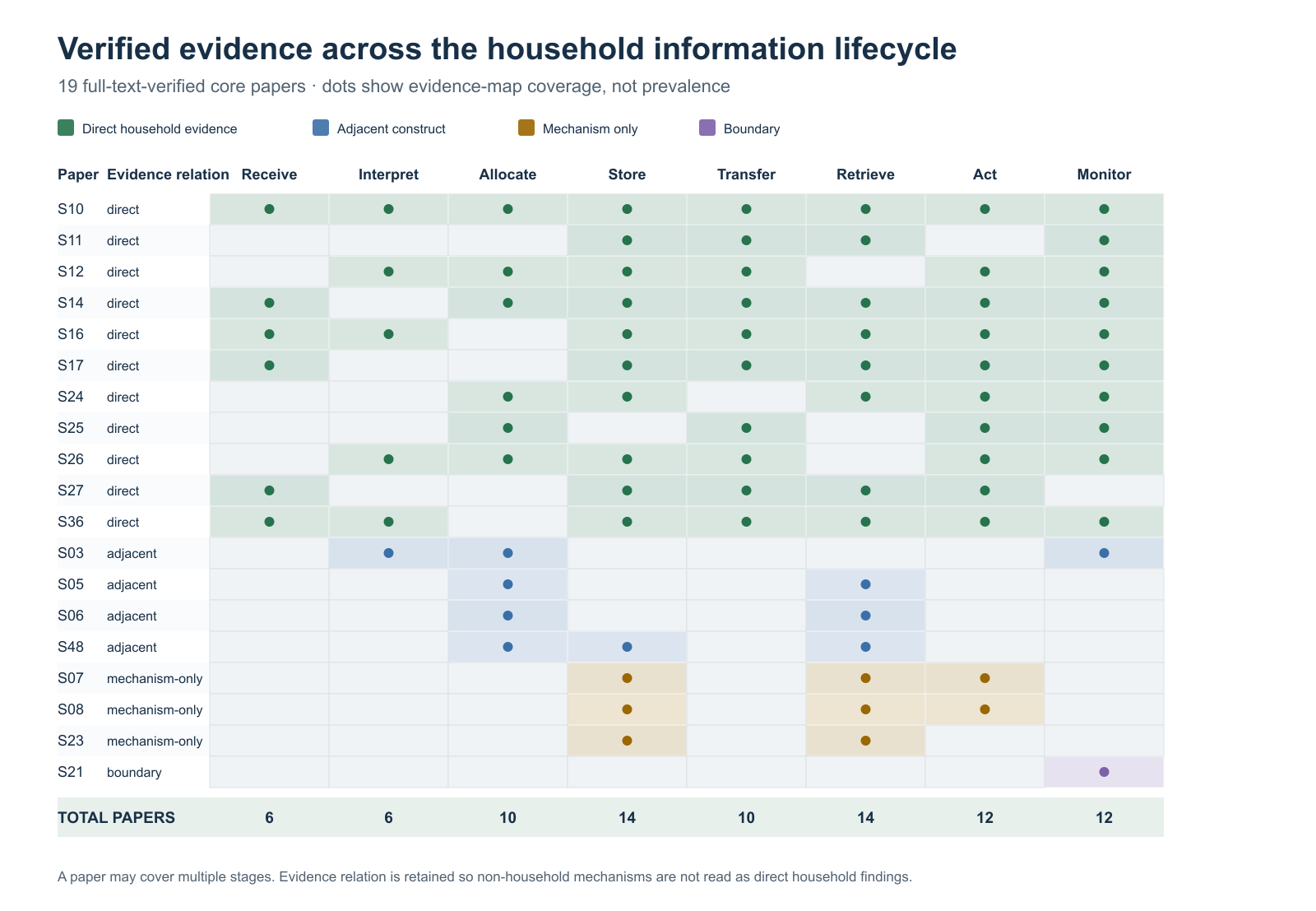
Figure 1. Verified core evidence across the household information lifecycle. Rows represent the 19 core papers whose full text was examined in the sections relevant to study design, evidence, and conclusions. A dot indicates that a paper covers that lifecycle stage. Colors preserve evidence relation—direct household evidence, adjacent construct, mechanism-only evidence, or boundary evidence—so cross-domain mechanisms are not mistaken for household findings. Counts describe evidence-map coverage, not household prevalence or failure rates.
Construct boundaries
Several established concepts overlap with household information fragmentation, but none is interchangeable with it.
| Construct | Main question | Contribution to this map | Why it is not a substitute |
|---|---|---|---|
| Cognitive labor / mental load | Who anticipates, decides, and monitors? | Explains who performs integration work | Responsibility can be unequal even when information is centralized |
| Transactive memory | Who knows or remembers what? | Treats people as information locations | Coordinated specialization can work well and need not be fragmented |
| Prospective memory / intention offloading | How are future actions remembered? | Explains reminders and external cues | Usually does not model access, versions, or multi-person responsibility |
| Personal information management | How does a person keep, find, and maintain information? | Supplies lifecycle and storage concepts | Usually assumes an individual rather than an asymmetric household system |
| Family calendaring | How does a household coordinate time? | Provides dense evidence about access, transfer, and awareness | Household information extends beyond scheduled events |
| Household chaos | Is the home noisy, disordered, or unpredictable? | Provides a neighboring environmental and outcome construct | It does not measure information structure or flow |
Household chaos deserves particular caution. A systematic scoping review links the construct to child, parent, and family outcomes, but the measures concern noise, disorder, crowding, routines, and unpredictability—not the path of information through a household (Marsh, Dobson, and Maddison, 2020). A chaos score should not be relabeled as an information-fragmentation score.
For narrower treatments of two neighboring mechanisms, see our evidence reviews of transactive memory in couples and intention offloading. Those pages retain the same distinction between direct findings and household-level inference.
What the evidence does not establish
The available literature supports a map of mechanisms, not a universal effect estimate.
- The five mechanisms have not been validated as one scale or one latent variable.
- No general fragmentation score has been shown to predict household wellbeing, relationship quality, or task completion.
- The evidence does not show that more channels necessarily produce worse outcomes.
- Many household HCI studies are small and qualitative. They provide rich mechanism evidence but not population prevalence.
- Laboratory evidence about cognitive offloading cannot be treated as a household intervention result.
- Cognitive labor, household chaos, transactive memory, and information fragmentation should not be collapsed into one construct.
- None of the reviewed studies proves that a particular software or AI system will solve these problems.
The map also has blind spots. Much of the direct household research focuses on couples with children, working parents, or caregiving situations. It offers less evidence about single-person households, multigenerational households, separated or blended families, people with limited digital access, and coordination across multiple homes.
A research agenda without a product roadmap
The next useful studies do not require a large new survey or a premature scale. Researchers could begin with observable information journeys:
- How many manual transfers occur between receipt and action for a real household obligation?
- Which information nodes are accessible to only one household member?
- Do household members agree about who owns interpretation, recording, action, and verification?
- When several versions exist, how do people decide which is current?
- Which breakdowns are best captured through artifact walkthroughs, paired interviews, diaries, or interaction logs rather than individual recall?
- How do information journeys differ across household forms, languages, institutions, and levels of digital access?
These questions preserve the distinction between documenting a problem and prescribing a product. They also make future evidence easier to compare across family studies, information science, HCI, and cognitive psychology.
Frequently asked questions
What is household information fragmentation?
Household information fragmentation describes coordination information distributed across multiple sources, media, accounts, people, or moments in time, creating the possibility of repeated entry, manual transfer, retrieval failure, inconsistent versions, unclear responsibility, or missed action. It is a working evidence-mapping definition, not a validated diagnostic scale.
Is household information fragmentation the same as mental load?
No. Mental-load and cognitive-labor research asks who anticipates, decides, and monitors. Household information fragmentation concerns where information resides, who can access it, how it moves, and how responsibility is allocated. The constructs can interact without being interchangeable.
Does using more apps necessarily create more fragmentation?
No. Several tools can form a well-coordinated system, while one shared tool can still leave access or responsibility unclear. The reviewed evidence does not establish that channel count alone causes worse household outcomes.
Is there a validated household information fragmentation scale?
No validated general scale was identified in this evidence map. The five mechanisms are an analytical framework derived from the mapped literature, not a single tested latent variable or population score.
Can researchers reuse the companion data?
Researchers can inspect and cite the versioned evidence matrix, core coding dataset, coding schema, search log, source policy, and full-text verification log linked below. The package contains bibliographic metadata and original coding rather than copyrighted article text.
Methods
This project is a structured evidence map rather than a systematic review or meta-analysis.
The matrix contains 60 academic records published from 1991 through 2026 across 16 literature clusters used as analytical groupings for this evidence map. Discovery combined database searches, DOI and metadata verification, and forward and backward citation chasing from anchor papers. We selected 24 core papers for structured coding; 19 had accessible full text that was examined in the sections relevant to study design, evidence, and conclusions. Five remained partial and were not eligible for direct quotation.
Each core paper was coded for:
- unit of analysis;
- household type and information domain;
- information location;
- lifecycle stages;
- fragmentation mechanisms;
- whether multiple channels, responsibility allocation, and information-to-action movement were measured;
- outcome type;
- evidence relation;
- claim strength; and
- full-text and quotation status.
Evidence relation was coded as direct, adjacent, mechanism-only, or boundary. This prevents a laboratory memory finding, a personal-computer study, or a household-chaos measure from being reported as direct evidence about household information flow.
Sources were limited to peer-reviewed papers, DOI and bibliographic services, publishers, public research databases, university repositories, research-institution publication archives, and author manuscripts. Competitor websites, product documentation, blogs, reports, case studies, and user stories were excluded from discovery, coding, and citation.
The evidence matrix, coding schema, search log, and full-text verification log are maintained as versioned companion materials.
Data availability and reproducibility
The companion research package contains:
- the 60-paper evidence matrix;
- the core coding dataset;
- the coding schema;
- the search log;
- the source policy; and
- the full-text verification log.
The matrix records bibliographic metadata and original coding, not copyrighted article text. Version 1.0 should be treated as a living evidence map: corrections and additions should receive a new dated version rather than silently changing the published record.
Conflict disclosure
The authors are developing a household-organization product. To reduce the risk that product positioning shapes the evidence base, this map excludes internal user data, does not compare products, and does not translate research gaps into a public feature roadmap. Inclusion and coding decisions are documented so that readers can inspect the boundary between observed evidence and interpretation.
Conclusion
Household information does not live only in apps or calendars. It lives across people, paper, institutional messages, files, accounts, routines, and memory. Research has already described many components of this system, but different fields have emphasized different units and stages.
A shared map makes two things visible. First, fragmentation can arise from sources, storage, access, transfer, and responsibility—not simply from using several tools. Second, the strongest evidence concerns specific mechanisms and settings, not a universal household-fragmentation score or a proven technological remedy.
That is a useful starting point: a way to ask more precise questions about how information becomes household action, while keeping the evidence separate from the product decisions that may follow.
References
Ancker, J. S., Witteman, H. O., Hafeez, B., Provencher, T., Van de Graaf, M., & Wei, E. (2015). The invisible work of personal health information management among people with multiple chronic conditions: Qualitative interview study among patients and providers. Journal of Medical Internet Research, 17(6), e137. https://doi.org/10.2196/jmir.4381
Bergman, O., Beyth-Marom, R., & Nachmias, R. (2006). The project fragmentation problem in personal information management. Proceedings of the SIGCHI Conference on Human Factors in Computing Systems, 271–274. https://doi.org/10.1145/1124772.1124813
Eschler, J., Kendall, L., O’Leary, K., Vizer, L. M., Lozano, P., McClure, J. B., Pratt, W., & Ralston, J. D. (2015). Shared calendars for home health management. Proceedings of the 18th ACM Conference on Computer Supported Cooperative Work & Social Computing, 1277–1288. https://doi.org/10.1145/2675133.2675168
Frampton, S. L., Gould, S. J. J., & Cox, A. L. (2026). The domestic operating system: An empirical investigation of digital technology and hidden work in the home. Proceedings of the 2026 CHI Conference on Human Factors in Computing Systems, 1–22. https://doi.org/10.1145/3772318.3791167
Gilbert, S. J., Boldt, A., Sachdeva, C., Scarampi, C., & Tsai, P.-C. (2022). Outsourcing memory to external tools: A review of intention offloading. Psychonomic Bulletin & Review, 30(1), 60–76. https://doi.org/10.3758/s13423-022-02139-4
Grimes, A., & Brush, A. J. (2008). Life scheduling to support multiple social roles. Proceedings of the SIGCHI Conference on Human Factors in Computing Systems, 821–824. https://doi.org/10.1145/1357054.1357184
Harris, C. B., Barnier, A. J., Sutton, J., & Keil, P. G. (2014). Couples as socially distributed cognitive systems: Remembering in everyday social and material contexts. Memory Studies, 7(3), 285–297. https://doi.org/10.1177/1750698014530619
Hewitt, L. Y., & Roberts, L. D. (2015). Transactive memory systems scale for couples: Development and validation. Frontiers in Psychology, 6, 516. https://doi.org/10.3389/fpsyg.2015.00516
Marsh, S., Dobson, R., & Maddison, R. (2020). The relationship between household chaos and child, parent, and family outcomes: A systematic scoping review. BMC Public Health, 20, 513. https://doi.org/10.1186/s12889-020-08587-8
McKenzie, P. J. (2021). Keeping track of family: Family practices and information practices. Library Trends, 70(2), 78–104. https://doi.org/10.1353/lib.2021.0016
Moen, A., & Brennan, P. F. (2005). Health@Home: The work of health information management in the household: Implications for consumer health informatics innovations. Journal of the American Medical Informatics Association, 12(6), 648–656. https://doi.org/10.1197/jamia.M1758
Neustaedter, C., Brush, A. J. B., & Greenberg, S. (2009). The calendar is crucial: Coordination and awareness through the family calendar. ACM Transactions on Computer-Human Interaction, 16(1), 1–48. https://doi.org/10.1145/1502800.1502806
Reich-Stiebert, N., Froehlich, L., & Voltmer, J.-B. (2023). Gendered mental labor: A systematic literature review on the cognitive dimension of unpaid work within the household and childcare. Sex Roles, 88(11–12), 475–494. https://doi.org/10.1007/s11199-023-01362-0
Risko, E. F., & Gilbert, S. J. (2016). Cognitive offloading. Trends in Cognitive Sciences, 20(9), 676–688. https://doi.org/10.1016/j.tics.2016.07.002
Sannon, S., Vorvoreanu, M., Walker, K., & Fourney, A. (2020). “Am I doing this all wrong?” Challenges and opportunities in family information management. Proceedings of the ACM on Human-Computer Interaction, 4(CSCW2), 1–28. https://doi.org/10.1145/3415209
Sohn, T., Lee, L., Zhang, S., Dearman, D., & Truong, K. N. (2012). An examination of how households share and coordinate the completion of errands. Proceedings of the ACM 2012 Conference on Computer Supported Cooperative Work, 729–738. https://doi.org/10.1145/2145204.2145315
Taylor, A. S., & Swan, L. (2004). List making in the home. Proceedings of the 2004 ACM Conference on Computer Supported Cooperative Work, 542–545. https://doi.org/10.1145/1031607.1031697
Vyas, D., Snow, S., Roe, P., & Brereton, M. (2016). Social organization of household finance. Proceedings of the 19th ACM Conference on Computer-Supported Cooperative Work & Social Computing, 1777–1789. https://doi.org/10.1145/2818048.2819937
Wegner, D. M., Erber, R., & Raymond, P. (1991). Transactive memory in close relationships. Journal of Personality and Social Psychology, 61(6), 923–929. https://doi.org/10.1037/0022-3514.61.6.923
Related reading
- How Household Information Work Is Measured
A methods audit of how researchers observe household information work: units of analysis, data sources, visible processes, and recurring blind spots.
- Meet Kinmory AI Recipes: Create, Import, Personalize, and Share
Discover AI Recipes in Kinmory, the family organization and planning app. Create recipes with AI, import from the web, personalize, and share.
- Where's the Wi-Fi Password? The Facts One Parent Holds
The wifi password, the allergies, the plumber's name: the household facts that quietly live in one parent's head — and how to move them off it.
- What Is Transactive Memory? How Families Share Knowledge
A research-grounded guide to transactive memory: its definition, evidence from couples, limits, and what it may explain about family mental load.
Bring your family's plans into one place.
Use Kinmory on the web or phone to share calendars, tasks, meals and the information your household needs next.

Scan to Download
Point your camera here
kinmory.ai/download/kinmory