

How to Help Kids Catch Careless Homework Mistakes
Help your child catch homework mistakes with three practical habits, a four-step checklist, and less nagging. A guide for parents by Anna Keller.
Three practical ways to help kids check their work—with fewer reminders and less frustration.
For parents of elementary-school children. Start with one or two checks for younger learners.
Your child can explain how subtraction works. They have solved problems like this before. But tonight, the worksheet says 18 − 7, and they write 25.
You point to the minus sign. “Oh,” they say, and change the answer immediately.
That is the frustrating part: they seem to know how to do it. So why does it keep happening?
It is tempting to say, “You need to be more careful.” But being careful is the result you want. Your child still needs a way to get there.
Try teaching a small checking routine: find the step that went off track, make that step easier to check, and help your child notice when the strategy works. Here is what that can look like at the kitchen table.
Why knowing the answer is not the whole job
Think of working memory as a small desk. It is the space where we keep information available while we use it. During a math problem, that desk might hold the instructions, the numbers, a method, and an unfinished calculation.
Now add a sibling talking, a question about dinner, or the urge to finish before a favorite show. It becomes easier to lose track of a detail.
Remembering the next step, paying attention, and changing your approach are skills children build over time. Researchers call this group of skills “executive function.” The Center on the Developing Child at Harvard University offers a useful introduction.
But a wrong answer does not tell you its cause. Your child might be tired, distracted, rushing, unsure what a word means, or still learning the method. A checklist will not teach a concept they do not understand.
Before deciding they were “just careless,” get curious about what actually happened. The useful question is: Which part needs support?
1. Ask your child to walk you through one problem
Choose one example, preferably when neither of you is already upset. You do not need to review every error on the page.
Instead of “Why did you get this wrong?” try:
- “Show me what you noticed first.”
- “What was the question asking you to find?”
- “What did you do next?”
Then give them room to answer. Resist the urge to interrupt as soon as you see the mistake. You are trying to understand their route through the problem.
For example, your child might say, “I saw eighteen and seven, so I added them.” That gives you something specific to work with: the operation sign was missed before the calculation began.
You could respond, “You added those numbers correctly. This problem asks us to subtract. What could help you notice the sign before you start?”
Together, you might decide to point to the sign and say the operation quietly before calculating. If marking the worksheet is allowed, circling the sign could be another option.
Sometimes the child will spot the problem while explaining. Sometimes they will need you to point it out. Both are useful. This is a conversation, not a test of whether they can discover the answer without help.
If they cannot explain the method even with support, pause the checking lesson. Work through an example together or ask their teacher how the method is being taught.
If talking feels like too much, let them point, draw, or show the steps with counters. The goal is to make the process visible, not to demand a polished explanation.
2. Turn “check your work” into four concrete actions
“Check your work” sounds clear to an adult. To a child, it may mean looking at the page again and hoping something stands out.
A short checklist tells them where to look. Start with the part that causes the most trouble, then add checks as they become manageable.
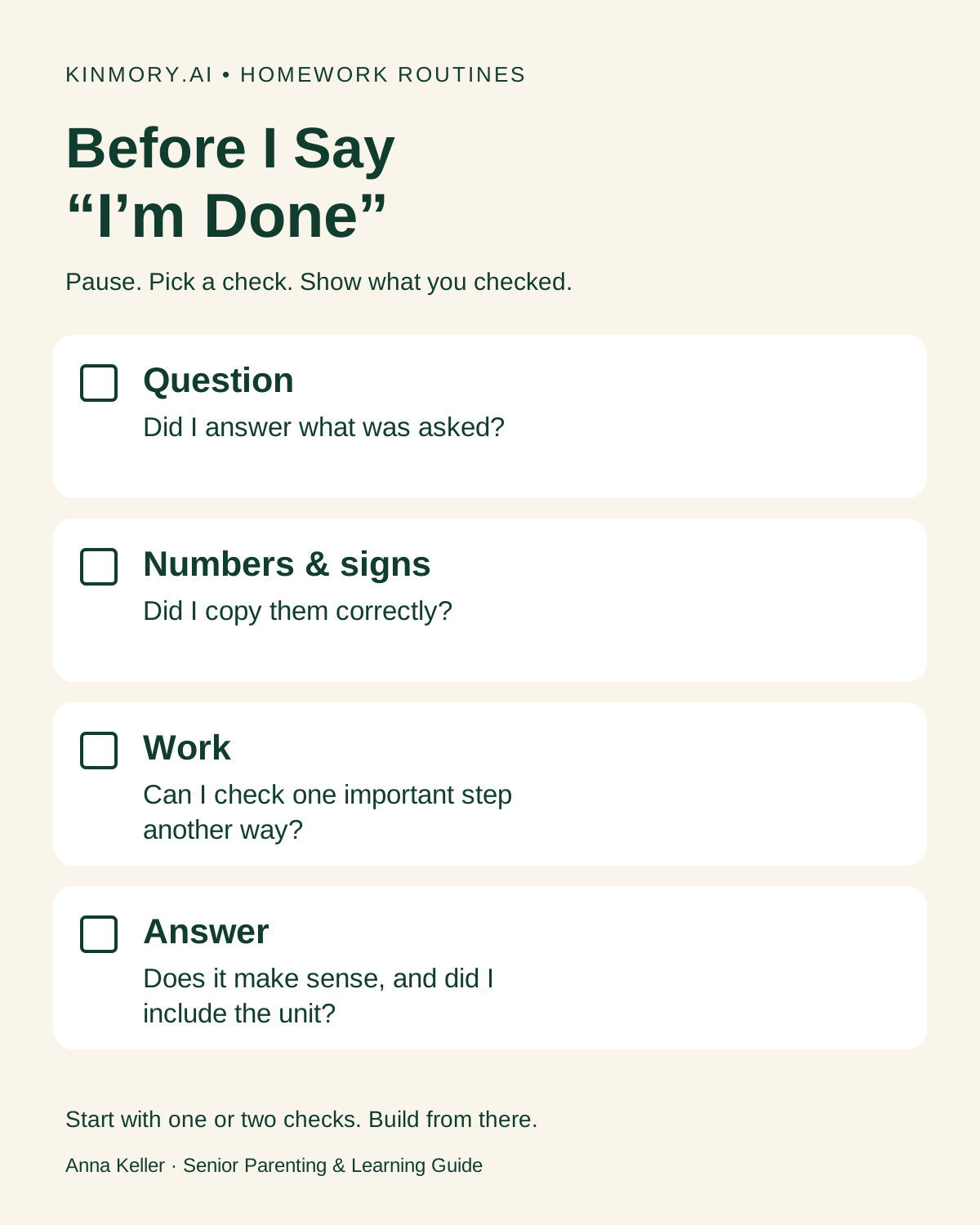
“Another way” could mean using addition to check subtraction, or checking the answer on a number line.
Save the four-step checklist or open the printer-friendly version.
Show what each check looks like
Suppose a problem says: “There are 18 markers in a box. Seven are used. How many are left?”
Question: Ask your child to point to “how many are left.” They are finding the remaining markers, not the number used.
Numbers and signs: Compare the problem with the written calculation. Are 18 and 7 copied correctly? Does subtraction match what happened?
Work: After getting 11, use an appropriate second method. If they know the connection between addition and subtraction, try 11 + 7 = 18. Younger learners might use objects or a number line.
Answer: Eleven is fewer than eighteen, which fits this story. Write “11 markers” if the assignment calls for a labeled answer.
Not every question needs four lengthy checks. Choose a representative problem to practice the routine, then agree on which checks to use across the assignment. Repeating every calculation can turn a useful habit into an exhausting second round of homework.
Adapt the list to the subject and the child
For a written response, the checks might be: Did I answer the prompt? Did I include the requested detail? Does each sentence make sense when I read it aloud? Did I check capitals and punctuation?
For a younger child, start with just two: “Check the sign” and “Check the answer.” For an older child, let them write the prompts in their own words. A checklist they understand is more useful than a perfect-looking one they ignore.
Keep it visible on the desk. It holds the reminders so your child does not have to keep remembering what to check next.
Demonstrate once: “I’m checking whether my answer matches the question.” Practice together, then gradually step back. The Education Endowment Foundation’s guidance on helping children think about their learning supports explicitly teaching learners to plan, monitor, and evaluate their work. The home routine here is a practical adaptation, not a separately tested program.
Make the reminder easy to find tomorrow
A paper card is a good starting point. If your family already uses Kinmory, its assigned and recurring tasks offer another place to keep the routine visible.
For example, set up a recurring task called “Check my homework” for your child on homework days. Keep the checklist beside their work, and mark the task complete after they use it. If separate reminders work better, use short task names such as “Check numbers and signs” and “Match my answer to the question.” Review the schedule and assignment together.
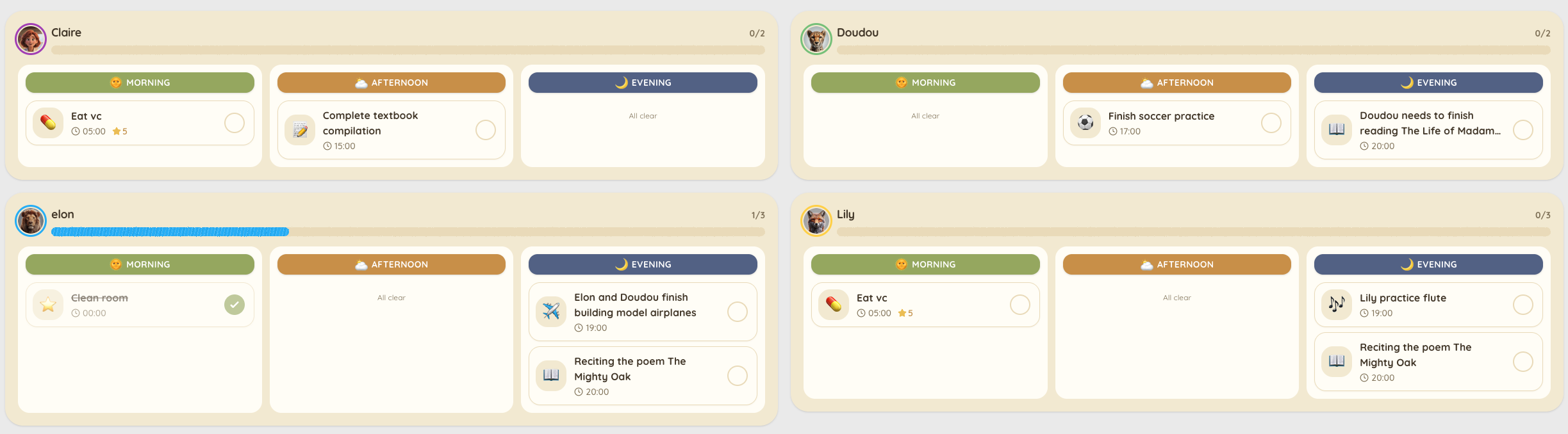
The tool keeps the reminder available. The learning happens when your child uses the check on their actual work.
3. Help your child notice what worked
When your child catches a mistake, pause long enough to connect the result with the action that helped.
Try: “You noticed the missing unit because you checked the last line. That check helped.”
Or: “Pointing to the sign helped you catch that one before you handed it in.”
That gives them a strategy they can use again. It also makes the checking step feel useful, rather than something adults require after the real work is finished.
You do not need to turn every mistake into a conversation about grades. Stay with the immediate connection: “I did this check, and it helped me notice this detail.”
At the end of the week, ask one question: “Which check helped you most?” If they want to keep a record, a small note is enough:
- Monday: I caught a plus sign I had copied incorrectly.
- Wednesday: I remembered to write “minutes.”
- Friday: I used the checklist before someone reminded me.
These are examples, not targets your child has to meet. An honest “I checked and didn’t find anything” is also a valid outcome. Never make finding an error a condition for being finished.
Look for independence as well as accuracy. Did they start the check themselves? Could they explain what they checked? Did they need one reminder instead of several?
A small plan for tonight
Keep the first attempt short. You are building a routine, not redesigning the entire evening.
- Pick one problem. Ask your child to show you how they approached it.
- Find one useful check. Choose a specific action connected to what happened.
- Write one prompt. Put it where they will see it while working.
- Let them try first tomorrow. Wait before stepping in, then help if needed.
If the routine adds tension, shrink it. One calm check is a better starting point than four steps that lead to an argument. If your child is exhausted, take a break before trying to teach something new.
If difficulties keep showing up across subjects, or homework regularly causes significant distress, talk with the teacher. Bring a couple of examples and ask what they notice in class. Together, you can work out whether the next step is clearer instructions, more teaching, a different routine, or additional support.
The aim is not a child who never makes mistakes. It is a child who has a practical answer to the question, “What can I check before I’m done?”
Watch Anna’s video walkthrough
Prefer to watch? This companion video introduces the homework-checking approach. The article above gives you the checklist and examples to return to afterward.
Watch the full 7-minute, 24-second video on YouTube.
For ideas on encouraging a routine once your child understands the steps, see our guide to using virtual pet rewards for children’s habits.
Related reading
- How Children Build Self-Direction in Grades 2–4
An evidence-informed framework for helping children start tasks, regulate effort, and become less dependent on adult prompting.
- How to Motivate Kids to Do Chores with Virtual Pet Rewards
Use immediate virtual pet feedback and longer-term family rewards to make chores easier to start—without turning every responsibility into a prize.
- A Family Organization System Should Survive a Busy Week
A resilient family organization system favors quick capture, visible next actions and easy recovery over perfect routines and constant maintenance.
- Why Busy Families Need an AI Assistant, Not Another Calendar
Kinmory.AI is an AI assistant for families that helps households understand scattered information, remember context, and take the next step.
Bring your family's plans into one place.
Use Kinmory on the web or phone to share calendars, tasks, meals and the information your household needs next.

Scan to Download
Point your camera here
kinmory.ai/download/kinmory