
When Your Child Screams After “No”: What Parents Should Do
A practical four-step response for tantrums after a child hears no: hold the boundary, keep everyone safe, reconnect, and teach better words.
A calm, repeatable response for the moment your child hears “no” and starts screaming.
For parents of toddlers, preschoolers, and young school-age children. Adapt the words to your child’s age and language level.
Your child spots a candy bar at the checkout. You say no.
Five seconds later, they are screaming. People are looking. You can feel yourself about to give in—not because you changed your mind, but because you desperately need the noise to stop.
Most parents know this moment. The fastest way to end it may seem obvious: buy the candy, add five more minutes of screen time, or hand back the toy.
But if “no” becomes “yes” after the screaming gets loud enough, your child can learn a very practical lesson: maybe a bigger tantrum will change the answer next time.
The goal is not to stop every tear or make your child agree with you. It is to teach a different pattern: disappointment is allowed, the boundary stays steady, and calm words bring the conversation back.
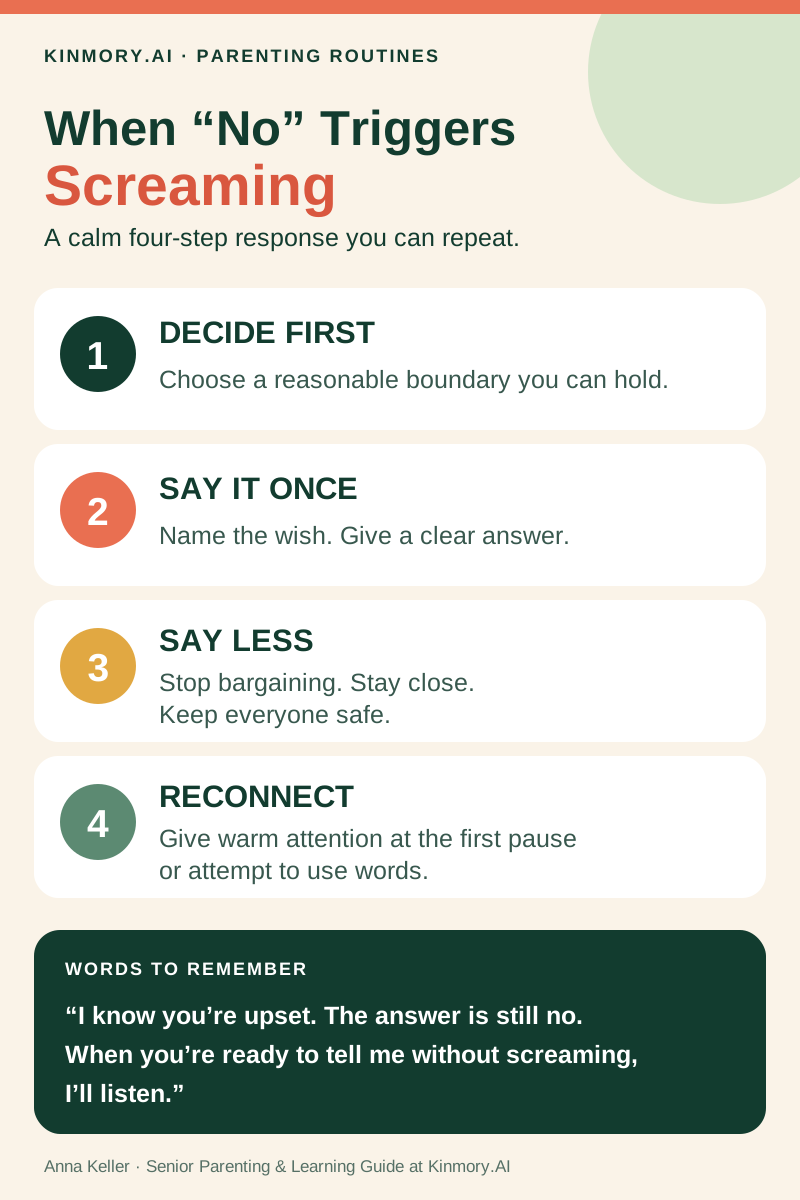
Save the four-step response card or open the printer-friendly version.
What you are trying to change
You are not trying to remove a strong personality. You are helping your child replace one learned response with a more useful one.
Children repeat behaviors that work. If screaming sometimes produces the treat, extra time, or escape they wanted, it makes sense that they will try screaming again. On the other hand, when screaming never changes the limit—but using words reliably brings back your attention—the child gets repeated practice handling frustration differently.
This distinction matters:
- The feeling is accepted: “You really wanted that. You’re disappointed.”
- The unsafe or unhelpful behavior is limited: “I won’t let you hit,” or, “I’ll listen when your voice is calmer.”
- The original decision stays separate from the tantrum: screaming does not reopen the negotiation.
This approach is consistent with parent guidance from the Centers for Disease Control and Prevention, which recommends limiting attention to safe minor misbehavior and returning positive attention as soon as it stops. It also fits the American Academy of Pediatrics’ guidance to stay consistent, while immediately stopping hitting, biting, kicking, throwing, or other dangerous behavior.
1. Before you answer, choose a boundary you can hold
A firm response starts before the tantrum. Take one breath and ask yourself: Is this a reasonable no?
If the answer is yes, make it clear. If you are genuinely open to discussion, discuss it before giving a final answer. Avoid saying “no” automatically and then entering a long negotiation.
Try:
- “We’re not buying candy today.”
- “Screen time is finished for tonight.”
- “You can look at the toy, but we are not taking it home.”
You are allowed to reconsider when new information changes the situation. Say so directly: “I thought about it again, and I’m changing my decision because…” The important point is that the reason is not the volume of the screaming.
2. Acknowledge the wish without changing the answer
Acknowledging your child is not the same as agreeing with them. In one or two sentences, name what they wanted and state the boundary.
“I know you want the candy. We’re not buying it today.”
Then stop. Long explanations can sound like the negotiation is still open, especially when the child is already upset.
Avoid:
- “Maybe, if you stop right now.”
- repeating five different reasons for the same answer;
- threats you do not intend to carry out;
- shaming: “Everyone is looking at you. You’re acting like a baby.”
A calm answer does not guarantee a calm reaction. Your job is to make the boundary understandable, not to make disappointment disappear.
3. When the screaming starts, say less
Give one calm reminder:
“I know you’re upset. The answer is still no. When you’re ready to tell me without screaming, I’ll listen.”
For a very young child, you can try one simple redirect: “Would you like to hold the shopping list or help me put the apples in the cart?” A small choice can help, but it should not include the item you already declined.
If the screaming continues:
- Stop explaining and bargaining. Repeating your case gives the tantrum a continuing audience and turns the moment into a debate.
- Keep your body and voice calm. Slow down. Use a low voice. If you feel close to yelling, focus on safety and pause the conversation.
- Stay nearby. A young or overwhelmed child may need your calm presence. You can offer a hug or a quieter place without changing the answer.
- Give less attention to the screaming itself. Do not lecture, plead, or negotiate. Wait for a small opening: a pause, a lower voice, eye contact, or words.
This is not silent punishment, rejection, or withholding love. You are staying available while removing the payoff from screaming. Guidance from the Raising Children Network similarly recommends staying close, acknowledging the emotion, avoiding reasoning during the peak of a tantrum, and not giving in to the demand.
4. Reconnect as soon as your child gives you something to work with
Do not wait for perfect calm or an apology. The first pause or attempt to use words is your opening.
Turn toward your child and say:
- “You’re telling me with words now. I’m listening.”
- “Your voice is quieter. Tell me what you want me to know.”
- “You’re disappointed, and you kept your hands safe.”
Be specific. “Good job” is pleasant, but “You told me you were angry without hitting” tells your child exactly what to do again. The CDC’s guidance on praise recommends giving positive attention quickly and naming the behavior you want to encourage.
Reconnecting does not mean reopening the original request. You can offer comfort, listen to the feeling, and continue with the plan: “I know. You still really want it. We’re going home now.”
Teach the replacement after the storm, not during it
When both of you are calm, keep the lesson short. Practice one sentence your child can use the next time they hear no:
- “I’m disappointed.”
- “Can you tell me why?”
- “Can I put it on my wish list?”
- “Can I have a hug?”
- “Can I choose something else?”
Role-play for 30 seconds. You say, “Not today.” Your child practices one of the sentences. Then switch roles if they enjoy it. The purpose is to make the new response easier to find when emotions are strong.
For younger children, use fewer words: “Mad,” “Help,” “Hug,” or “Later?” A child cannot use a replacement skill they do not yet have.
What if the tantrum gets worse at first?
It may. If screaming has changed your answer before, your child may try longer or louder to see whether the old strategy still works. The CDC advises parents to expect this possibility when they begin redirecting attention away from a behavior.
That does not mean you must ignore genuine distress. Stay close, help your child regulate, and keep everyone safe. What stays consistent is the boundary: comfort is available; the candy, extra screen time, or toy does not appear because of screaming.
Make sure the adults who regularly care for your child use the same basic pattern. The exact wording can differ, but the lesson should remain predictable:
Feelings are welcome. Unsafe behavior is stopped. Screaming does not change the answer. Calm communication brings connection.
A simple practice plan for this week
- Choose one recurring situation. Start with one pattern, such as requests for treats at checkout or extra screen time.
- Agree on one sentence. Every caregiver uses a short version of: “I know you’re upset. The answer is still no. I’ll listen when you’re ready to use words.”
- Choose the replacement. Teach one phrase your child can realistically use.
- Notice the first small success. A shorter scream, safe hands, one pause, or one word is progress worth naming.
- Review after a week. Ask: Did we stay consistent? Did we reconnect quickly? Does our child need a simpler phrase or more help calming?
Measure the adults’ consistency before measuring the child’s results. The first goal is not “no more tantrums.” It is a response you can repeat without giving in, escalating, or disconnecting.
If the conflict usually begins when a game or video ends, start earlier with Anna’s three-step screen-time transition routine. A predictable warning, one concrete next action, and a small choice inside the boundary can make that specific “no” easier to handle.
When to ask for professional help
Tantrums are common in young children, but get advice from your child’s pediatrician or a qualified child mental-health professional when outbursts are unusually frequent or prolonged for your child’s age, regularly happen across settings, interfere with school, friendships, or family life, or involve dangerous aggression, deliberate self-harm, or an inability to calm.
The American Academy of Child and Adolescent Psychiatry offers age-based guidance and warning signs. Seeking help is not an admission that you have failed; it is a way to understand what support your child and family need.
Frequently asked questions
Does acknowledging the feeling reward the tantrum?
No. “You’re disappointed” acknowledges the emotion; buying the candy because the screaming continued would change the outcome. You can offer warmth and comfort while keeping the original answer unchanged.
Should I completely ignore my child?
No. Stay close enough to support and protect your child. Reduce the arguing, pleading, and bargaining around the screaming itself. If your child is genuinely distressed and cannot calm without help, offer calm reassurance without reopening the demand.
What if I realize my original answer was unfair?
Parents can reconsider. Make the reason explicit: “I answered too quickly. I’m changing my decision because I checked the plan.” This teaches thoughtful flexibility. Try not to make the change depend on how loudly or how long your child screams.
How long will this take to work?
There is no reliable countdown. The behavior may briefly get louder or last longer when an old strategy stops working. Look for gradual changes: safer hands, a shorter outburst, an earlier pause, or words appearing sooner. If the pattern remains severe, unsafe, or highly disruptive, seek individualized guidance.
Watch Anna’s two-minute walkthrough
See the response in sequence and hear the exact phrases Anna recommends using in the moment.
Watch “When Your Child Screams After ‘No’” on YouTube.
Sources and further reading
- CDC: Tips for Redirecting Your Attention
- CDC: Tips for Using Praise and Rewards
- HealthyChildren.org: Top Tips for Surviving Tantrums
- Raising Children Network: Toddler Tantrums
- NHS: Temper Tantrums
- AACAP: Temper Tantrums and Outbursts
This article provides general educational information and is not a substitute for individualized medical or mental-health advice.
Related reading
- How to Help Your Child Become Interested in Learning
A practical guide for parents: spot genuine interests, connect them to school skills, offer meaningful choice, and build motivation without constant pushing.
- Should Parents Check Every Homework Answer?
A one-question homework check-in that helps parents spot confusion without correcting every answer or taking over.
- How to Help Kids Catch Careless Homework Mistakes
Help your child catch homework mistakes with three practical habits, a four-step checklist, and less nagging. A guide for parents by Anna Keller.
- Screen Time Meltdowns: A 3-Step Transition Routine
Help your child end screen time with less conflict using a three-step transition routine, practical scripts, age-based examples, and a seven-day plan.
Bring your family's plans into one place.
Use Kinmory on the web or phone to share calendars, tasks, meals and the information your household needs next.

Scan to Download
Point your camera here
kinmory.ai/download/kinmory