

Should Parents Check Every Homework Answer?
A one-question homework check-in that helps parents spot confusion without correcting every answer or taking over.
Homework without the takeover
Should Parents Check Every Homework Answer?
Checking every line can feel responsible. It can also turn a parent into the household quality-control department—and hide the exact point where a child needs to think.
Direct answer: usually, no. Unless a teacher has asked for full correction, a short check-in is often more useful than reviewing every answer. Ask your child to explain one problem, notice where the thinking became difficult, and decide on one next step. The goal is not a perfect page tonight. It is a child who becomes more able to monitor their own work over time.
Your child closes the workbook and says, “Done.” You see a page of answers. Some look right. One is obviously wrong. Then the familiar choice appears: let the page go to school, or sit down and check every line.
Many caring parents choose the second option. It seems efficient: catch the errors now, protect the grade, and prevent tomorrow’s disappointment. But if the adult becomes the final checker every evening, the child may learn a different routine from the one the family intended:
I finish. An adult decides whether it is really finished.
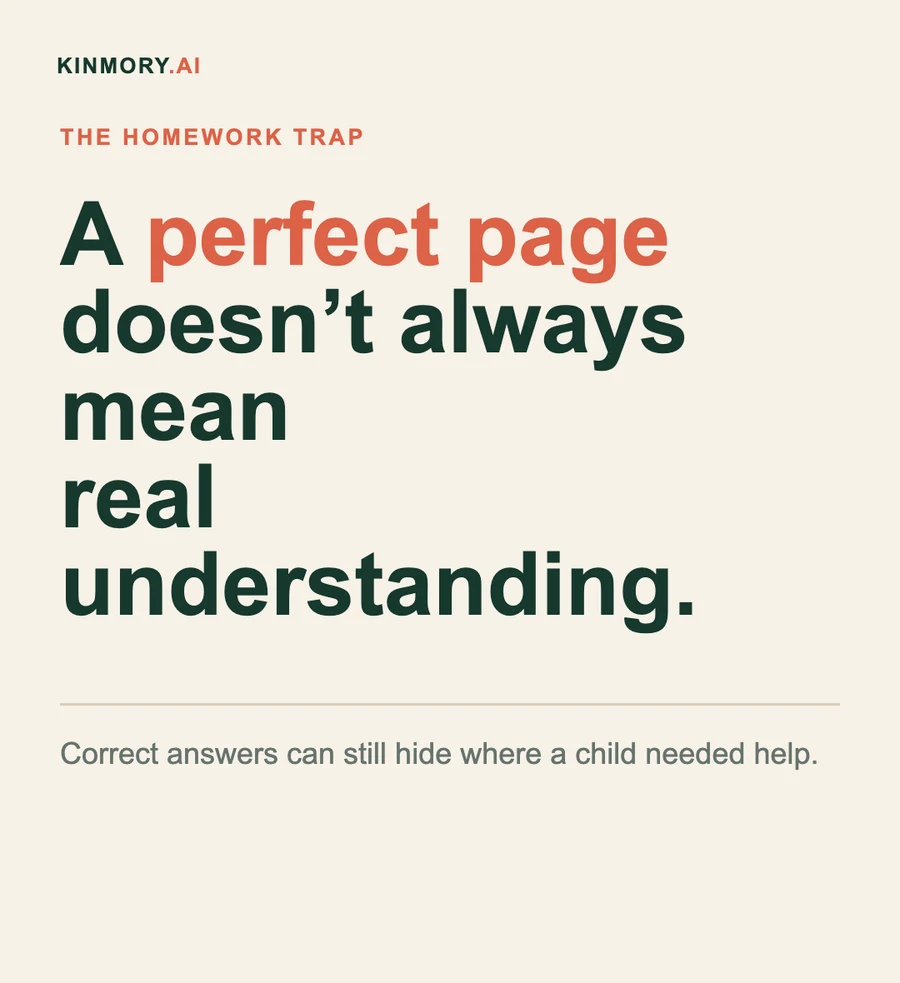
Why a perfectly corrected page may tell the teacher less
Homework has more than one job. It can give a child practice, help them retrieve what they learned, and reveal what they can do without immediate classroom support. It can also give a teacher information. A cluster of mistakes may show that an instruction was misunderstood, a method is not yet secure, or a particular step needs reteaching.
When a parent corrects every answer before the work returns to school, some of that information disappears. The page may look stronger while the underlying confusion remains.
This does not mean parents should become deliberately unhelpful. It means the form of help matters. A 2024 meta-analysis covering 28 studies and more than 378,000 participants found that parental autonomy support was the only homework-involvement dimension positively related to achievement; content support, control, frequency, and mixed involvement were largely unrelated. The finding is correlational and does not prove that one routine will work for every family, but it supports an important distinction: helping a child think is different from taking over the thinking.
Quality control
- Check every answer.
- Point out each mistake.
- Keep going until the page is correct.
- Adult decides when the work is done.
Learning support
- Sample one useful problem.
- Ask the child to explain the approach.
- Identify one strategy or question.
- Child keeps ownership of the work.
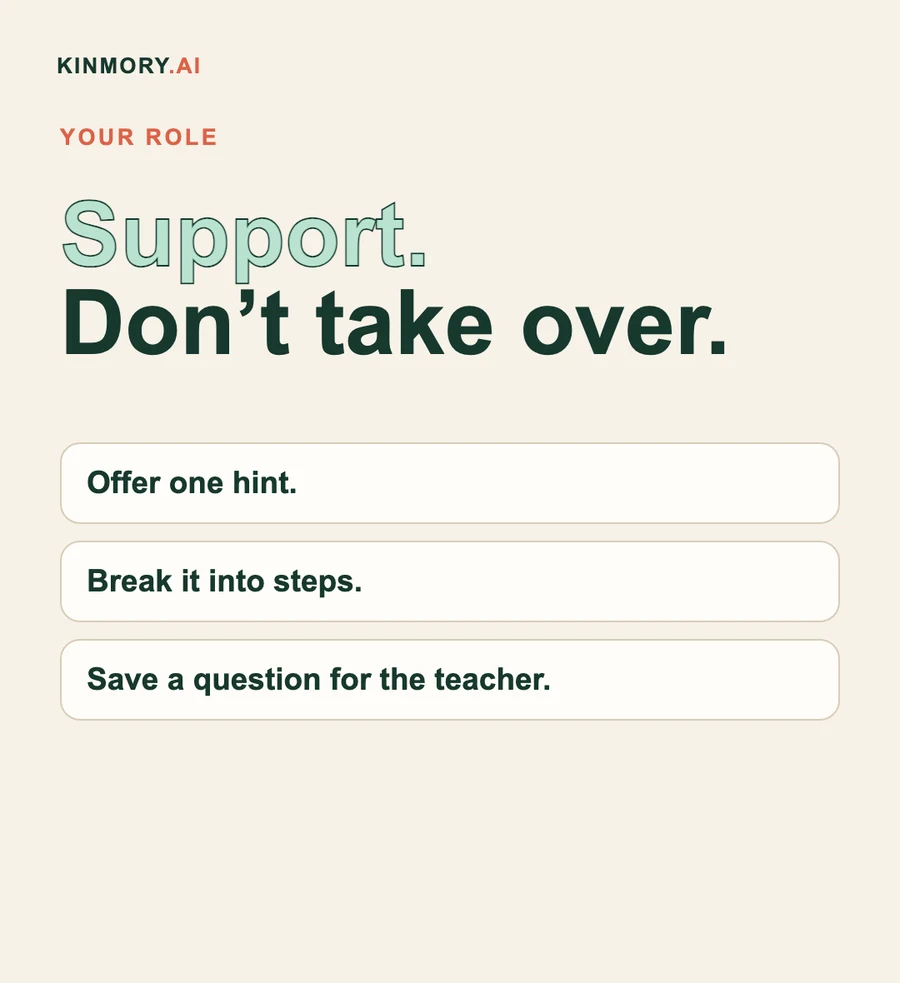
The One-Question Check-in
The One-Question Check-in is a short routine for the end of homework. It is not a test, a second lesson, or a hunt for a mistake. It is a way to make one piece of the child’s thinking visible.
Three steps, one problem
- Ask your child to choose one problem.
It can be a problem they feel proud of, one that felt tricky, or one they are unsure about. - Ask them to explain what they did.
Try: “What did you notice first?” “What was your plan?” or “Where did it become difficult?” - Choose one next step.
The child might correct a copied number, try a known checking strategy, mark a question for the teacher, or leave the work as it is so the teacher can see the confusion.

The routine is deliberately small. If the parent samples one problem instead of scanning the entire page, the conversation can stay about thinking rather than compliance. The child gets practice planning, monitoring, and evaluating—skills often described as metacognition and self-regulated learning.
For a broader evidence-informed framework on gradually reducing adult prompts, see how children build self-direction in Grades 2–4.
The Education Endowment Foundation’s updated guidance emphasizes that these strategies need explicit teaching, modelling, guided practice, and gradual movement toward independence. In other words, “check your work” is not a complete instruction. Children may need to see what a useful check looks like before they can do it alone.
A 60-second parent script
Parent: “Choose one problem to show me.”
Child: “This one.”
Parent: “Tell me what you did first.”
Child: “I added because I saw 18 and 7.”
Parent: “What does the question say happened to the seven?”
Child: “They were taken away. I think it should be subtraction.”
Parent: “Good catch. What could help you notice that next time?”
What if your child chooses an easy problem?
That is not automatically avoidance. An easy problem can still show whether the child can explain a method clearly. It also lowers the emotional stakes while the family learns the routine.
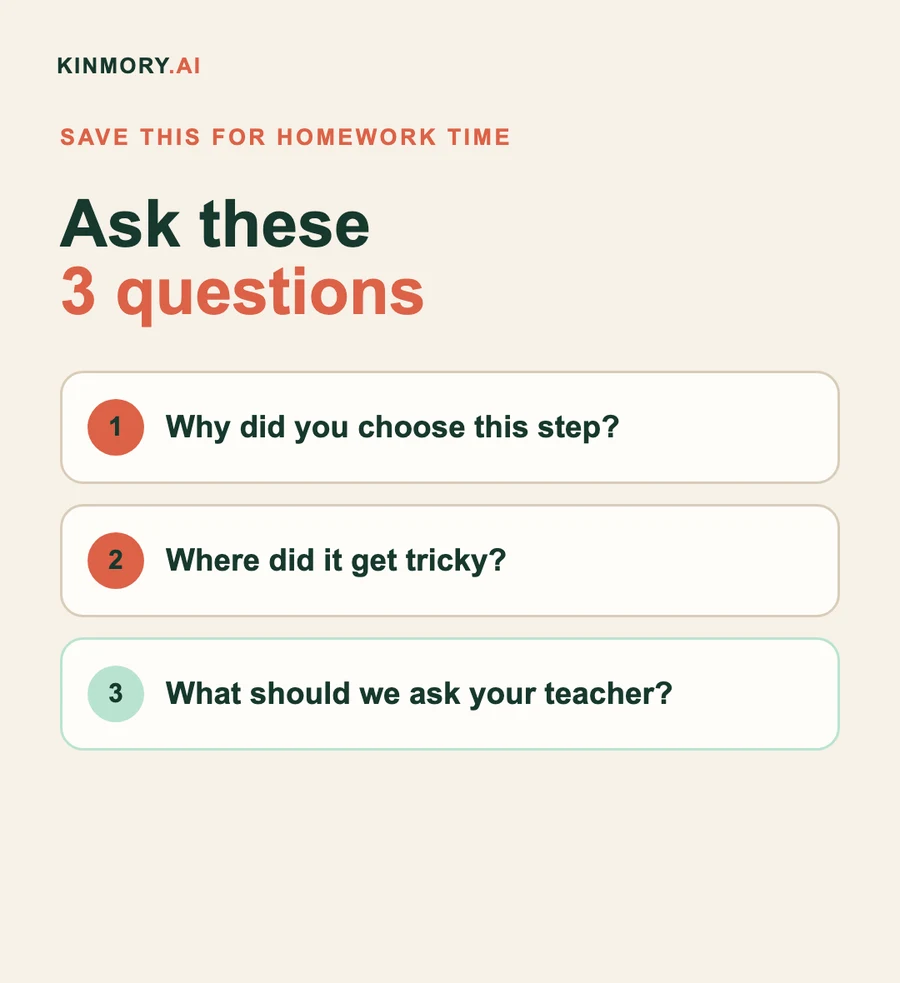
If the child always chooses the quickest item, add a light boundary: “You choose today; tomorrow I choose.” Another option is to rotate among three prompts:
- Show me one problem you feel confident about.
- Show me one place where you had to stop and think.
- Show me one question you would ask your teacher.
The purpose is not to catch the child hiding something. It is to build a repeatable habit of noticing how learning is going.
When parents should step in more
“Do not check every answer” is not a universal rule. Family routines should follow the child’s age, current skills, school expectations, and any learning plan or professional guidance.
Use more direct support when:
- the teacher has specifically asked families to correct or sign the work;
- a younger child is still learning what the instructions mean;
- the child cannot begin because the underlying concept is not understood;
- an IEP, 504 plan, SEN support plan, individual education plan, or local equivalent calls for a particular kind of help;
- the task is practice for a near-term assessment and review is part of the agreed plan;
- homework regularly causes intense distress, shutdown, or conflict.
When the concept itself is missing, a checking routine is not enough. Model one example, use the method the teacher has taught, or send a brief note asking what kind of support would be most useful. If the same difficulty appears across subjects or persists for weeks, bring specific examples to the teacher rather than assuming the child is careless or unmotivated.
If the main challenge is getting a useful conversation started, use the open questions in How to Talk With Your Child Without Turning It Into an Interrogation.
What to leave for the teacher
A visible question can be more useful than an invisible rescue. Depending on school policy, your child might circle the problem, add a small question mark, or write one short note:
- “I understood the first step but not the second.”
- “I was not sure which operation to use.”
- “I checked this twice and still got different answers.”
For younger children, the parent can add a neutral note: “We stopped here because this method was not yet clear.” Avoid rewriting the work or turning the note into a judgment about effort.
A three-night way to introduce the routine
Then make the support smaller. You might move from three prompts to one, from sitting beside the child to checking in at the end, and eventually from asking aloud to letting the child use a short card independently.
Watch the 80-second version
Anna Keller demonstrates the One-Question Check-in in this short video.
The presenter is AI-generated. The routine is educational guidance, not a substitute for instructions from your child’s teacher or individualized professional support.
How Kinmory can support the routine
A tool should reduce remembering, not create more supervision. In Kinmory, a family can add a short recurring task such as “Choose one homework question to explain” on the evenings it is useful. Keep the task small enough for the child to recognize and complete.
Kinmory does not need to grade the page or decide whether the child is right. Its useful role is to keep the family’s agreed routine visible, assign ownership, and help the prompt appear consistently without one parent carrying it in their head.
Frequently asked questions
Should parents correct wrong homework answers?
Not automatically. Follow the teacher’s instructions. When full correction has not been requested, help the child explain one problem, identify the difficult point, and decide whether to try a known strategy or leave a question for the teacher.
Is it bad to check my child’s homework?
No. The issue is not whether a parent ever looks at homework; it is whether the child keeps ownership of the thinking. A brief, autonomy-supportive check-in is different from correcting every line or refusing to let imperfect work return to school.
What if the teacher expects homework to be correct?
Follow the teacher’s stated policy and ask what kind of parent help is appropriate. You can still preserve ownership by asking the child to explain, choose a checking strategy, and make the correction rather than supplying the answer.
What age is the One-Question Check-in for?
It can be adapted for primary or elementary students through early secondary or middle school. Younger children may need concrete prompts and modelling. Older students can choose the problem, name the strategy, and decide what question to take to the teacher.
What if homework always ends in conflict?
Shorten or pause the routine when everyone is overwhelmed. If distress or conflict is frequent, bring examples to the teacher and discuss task difficulty, workload, learning needs, sleep, attention, and appropriate support.
Video transcript summary
- Choose one problem.
- Ask your child to explain the thinking.
- If the explanation is clear, step back. If not, locate the stuck point and offer one hint rather than the answer.
Related reading
- How to Help Your Child Become Interested in Learning
A practical guide for parents: spot genuine interests, connect them to school skills, offer meaningful choice, and build motivation without constant pushing.
- When Your Child Screams After “No”: What Parents Should Do
A practical four-step response for tantrums after a child hears no: hold the boundary, keep everyone safe, reconnect, and teach better words.
- How to Help Kids Catch Careless Homework Mistakes
Help your child catch homework mistakes with three practical habits, a four-step checklist, and less nagging. A guide for parents by Anna Keller.
- Screen Time Meltdowns: A 3-Step Transition Routine
Help your child end screen time with less conflict using a three-step transition routine, practical scripts, age-based examples, and a seven-day plan.
Bring your family's plans into one place.
Use Kinmory on the web or phone to share calendars, tasks, meals and the information your household needs next.

Scan to Download
Point your camera here
kinmory.ai/download/kinmory